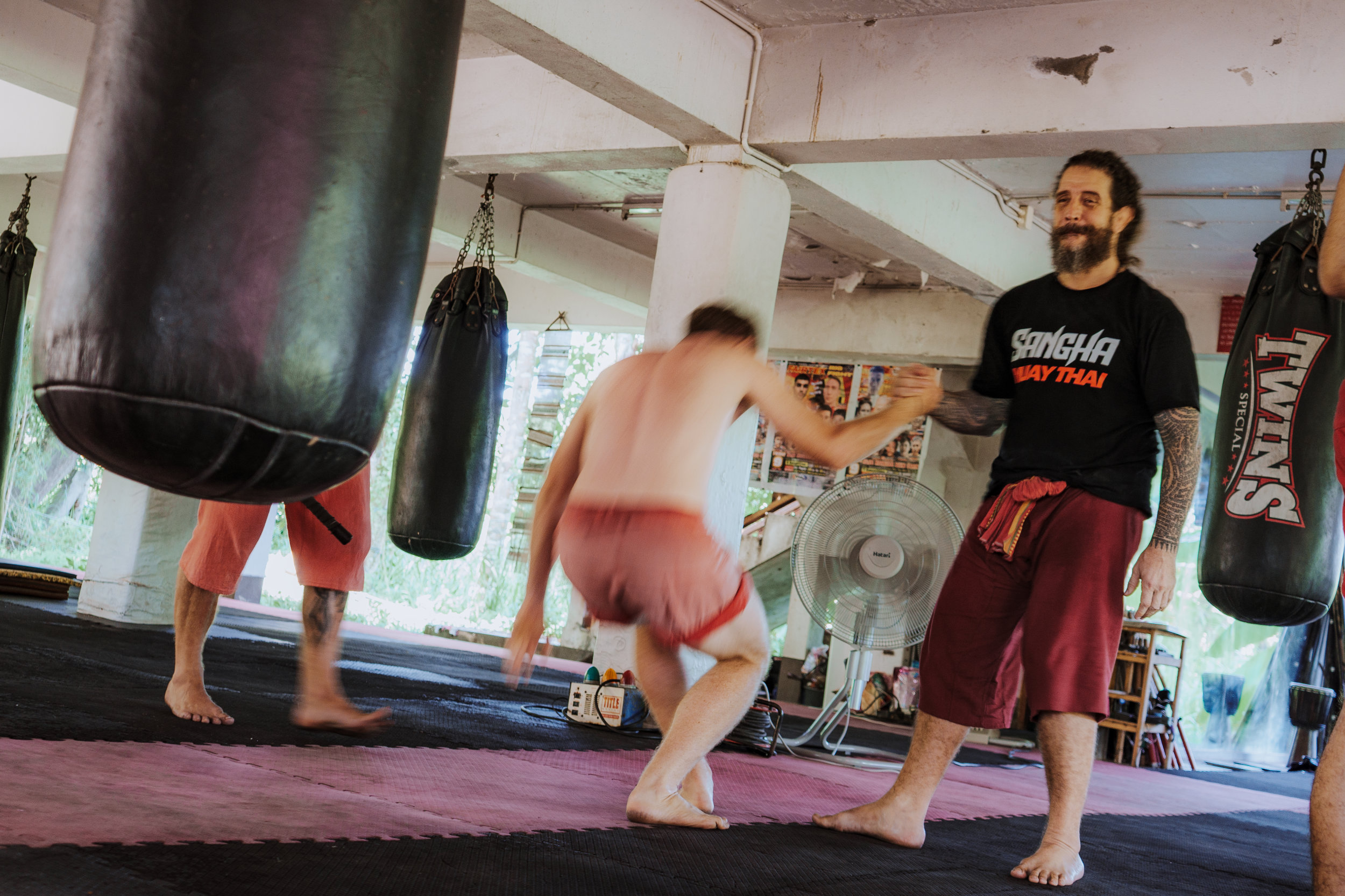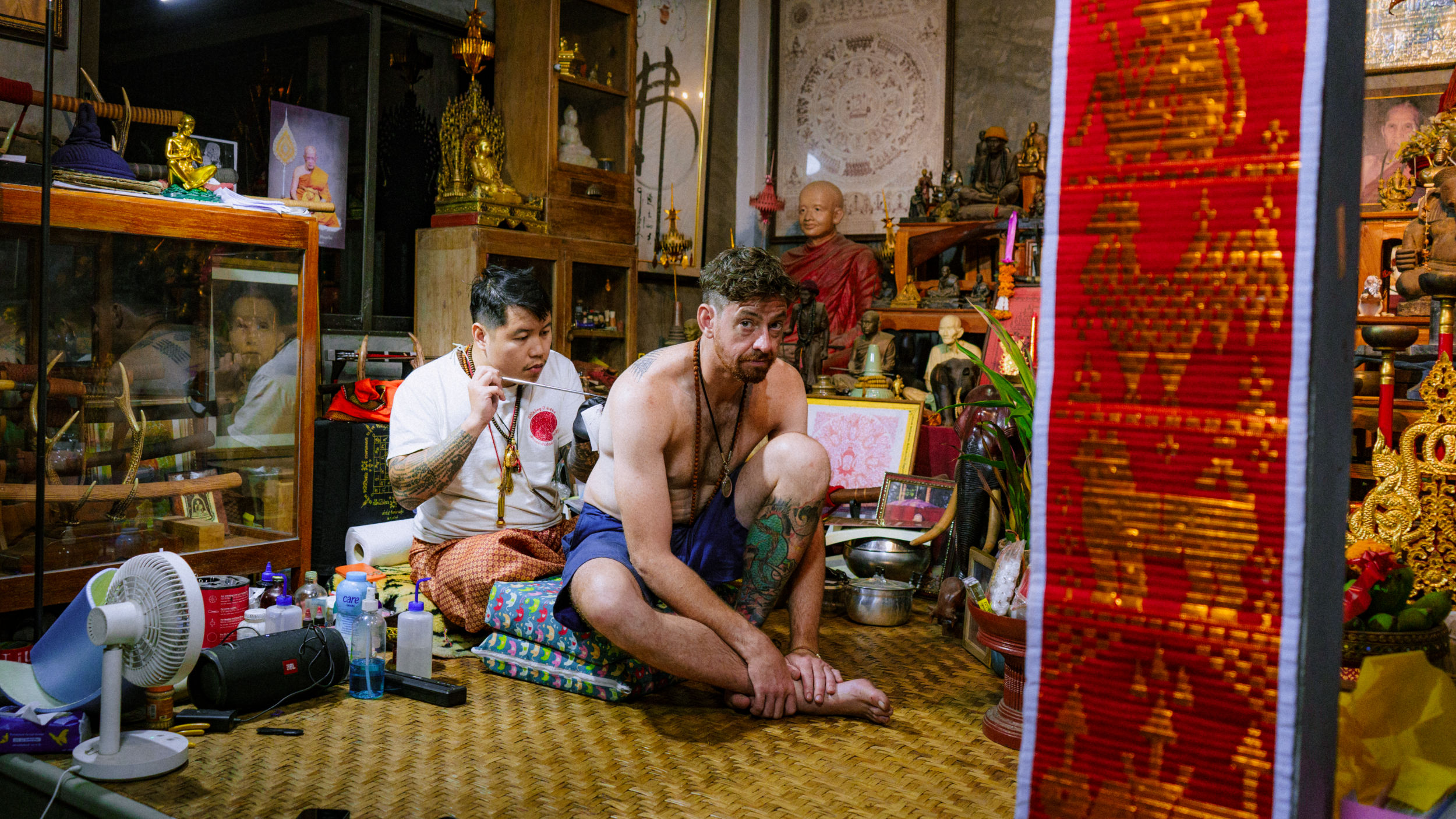
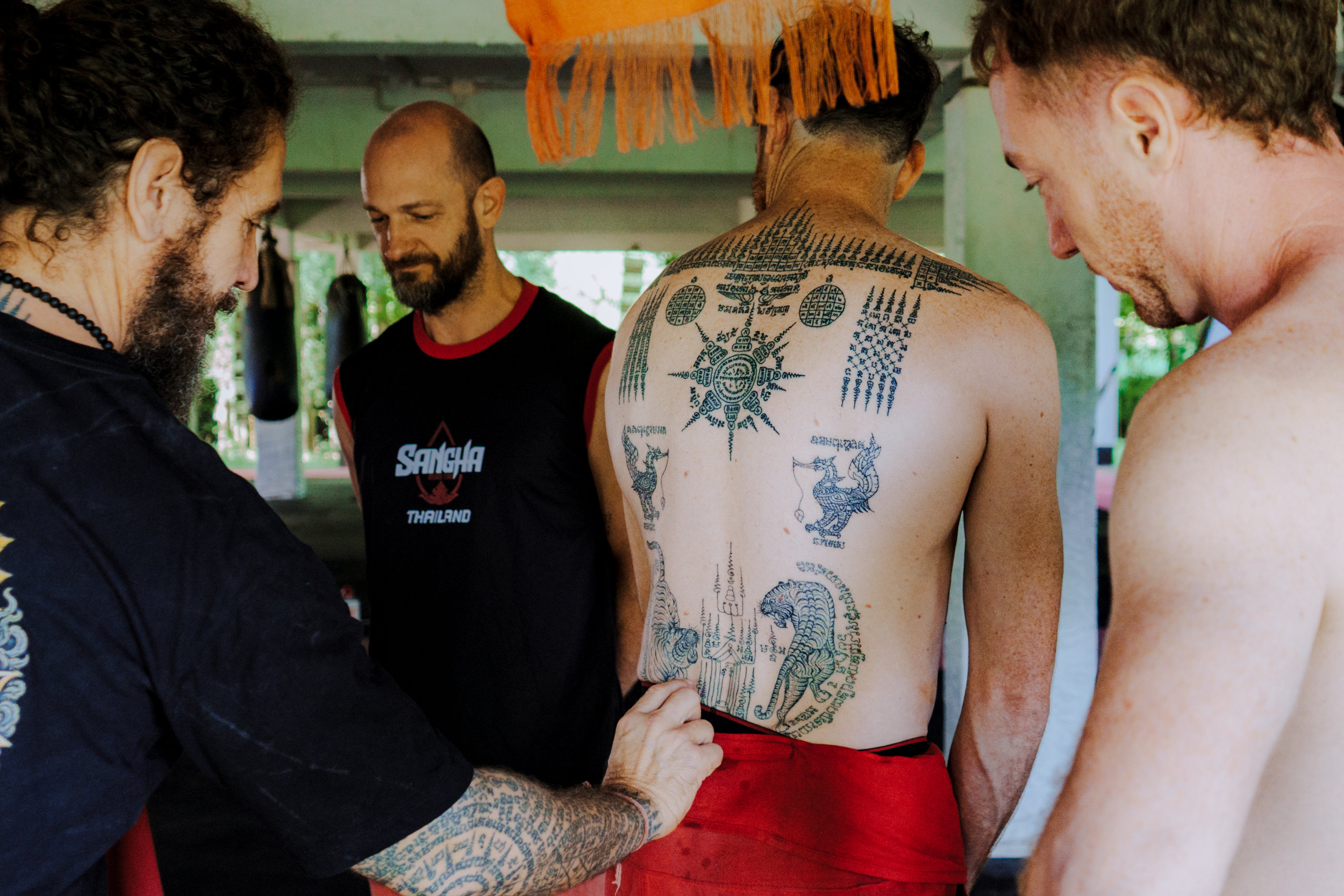
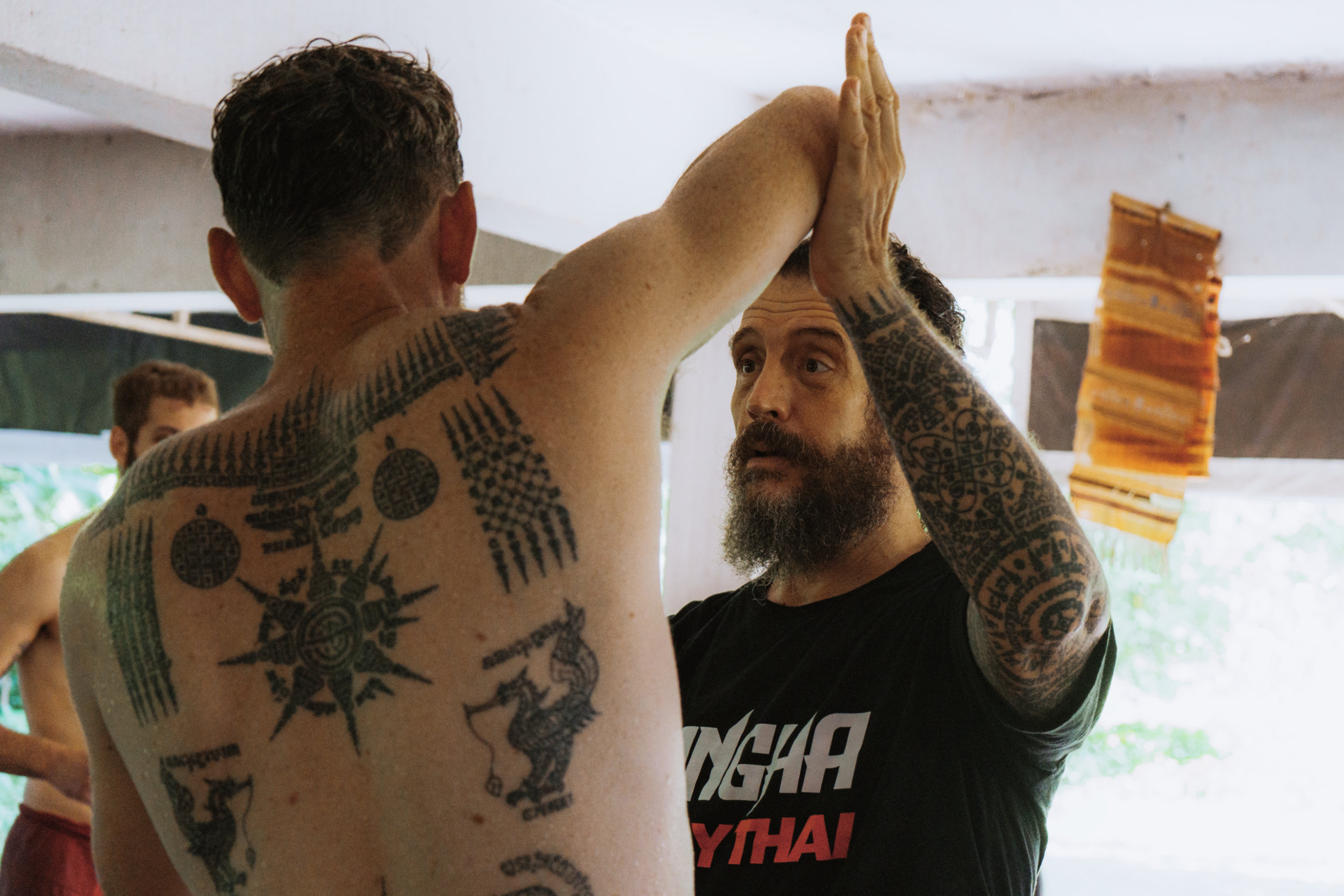
I wanted something to mark the occasion,” Jon explained to me as I watched the tattooist stab a thin needle repeatedly into his back. It had been years since he last trained in the martial art of Muay Sangha, which centers around the internal arts; a series of spiritual practices. That evening he was receiving the traditional Buddhist tattooing ceremony of Sak Yant. It’s a custom that dates back over a thousand years meant to protect the warriors of the kingdom of Ayutthaya, but today it lives on as a tradition in Thai martial arts for fighters who have committed their life to the craft.
The London-native had been a long-time practitioner of the fighting craft, though he’d left it all behind for years. This ceremony was his recommitment to the path. Here in Thailand, he will spend a month in the country-side with a small group to refresh his skills and learn under the same master who taught him almost 19 years before.
“Personally, I’m going through a spiritual journey [in] the Sangha Spiritual Warriors camp,” he said, "and right now I’m trying to work on my spiritual awareness.” Now approaching 40, it’d become apparent to him that he’d grown weary of spirit. There was a valuable lesson from the art of fighting that Jon felt the need to be reminded of.
“I’ve never met someone that offers the same level of spiritual guidance as Kru Pedro offered me. Back then he was a bit more of a hard-ass than he is now (…) but when someone commands that level of respect then you don’t mind the discipline you know? ‘Cause you know you’re getting a lot out of it. He’s sharing a lot with you that you wouldn’t be able to get anywhere else. (…) If you’re there, you’re there for a reason, which is to shut up and listen."
The tattooist dipped his needle in some more ink, and Jon went on. "For someone like me which, you know, I’m a bit of a class clown… doesn’t always go down so well. That’s why I got a few bruises.” He laughed.
I was curious about the journey he was on at this spiritual Fight Club of sorts. Why would he make his way from the UK all the way to Thailand? Why was this journey so important that it mattered for him to receive these tattoos to remember this experience? Jon decided it was time for a break from all the needling, so we sat outside and were served a hot bowl of Thai pork noodles to let the nerves of his back cool off.
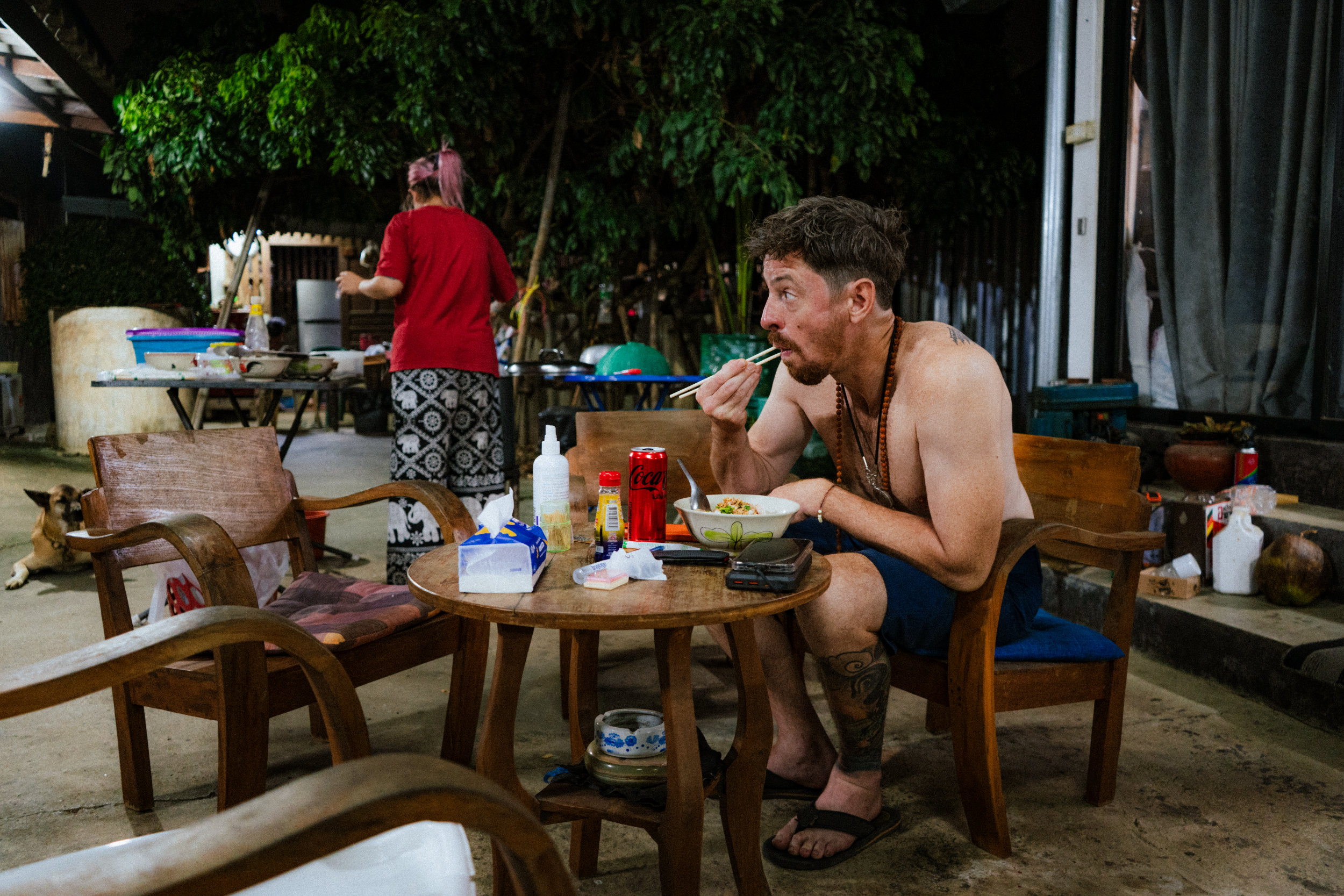
“This one in particular represents transformation and growth,” he told me about his new tattoo-in-progress, “and it also represents prosperity.” After falling off the path for many years, it was clear that he didn't want to fall again. This Sak Yant will certainly stick with him for the rest of his life, and hopefully, so too will the life lessons that come with it.
“But life get’s in the way, doesn’t it?” he said.
“It most certainly can,” I responded.
An Unconventional Master
I arrived to the Sangha Spiritual Warriors school early the following week to observe what daily life is like for students under Kru Pedro. It was a humble facility surrounded by farmland about an hour north of Chiang Mai City.
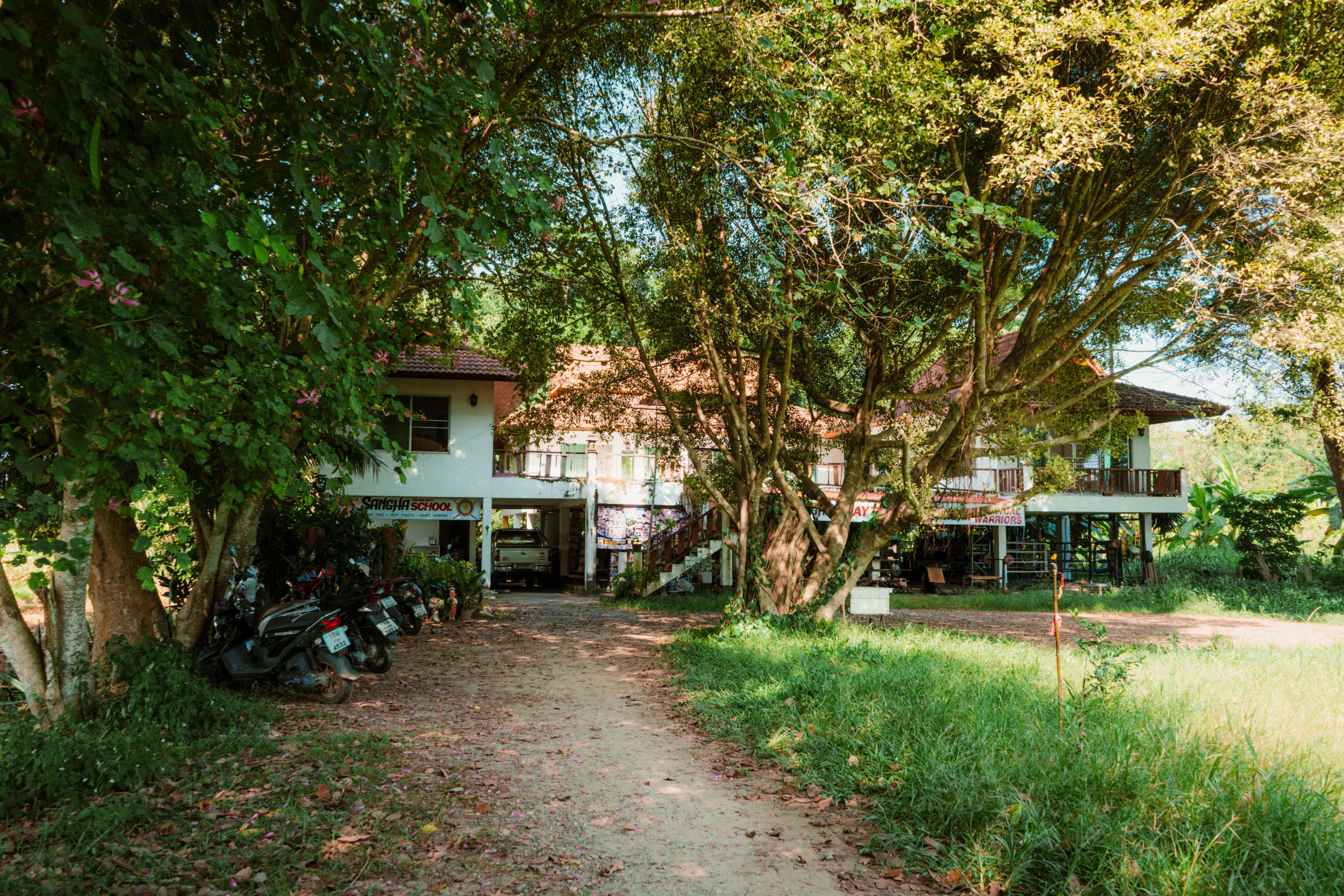
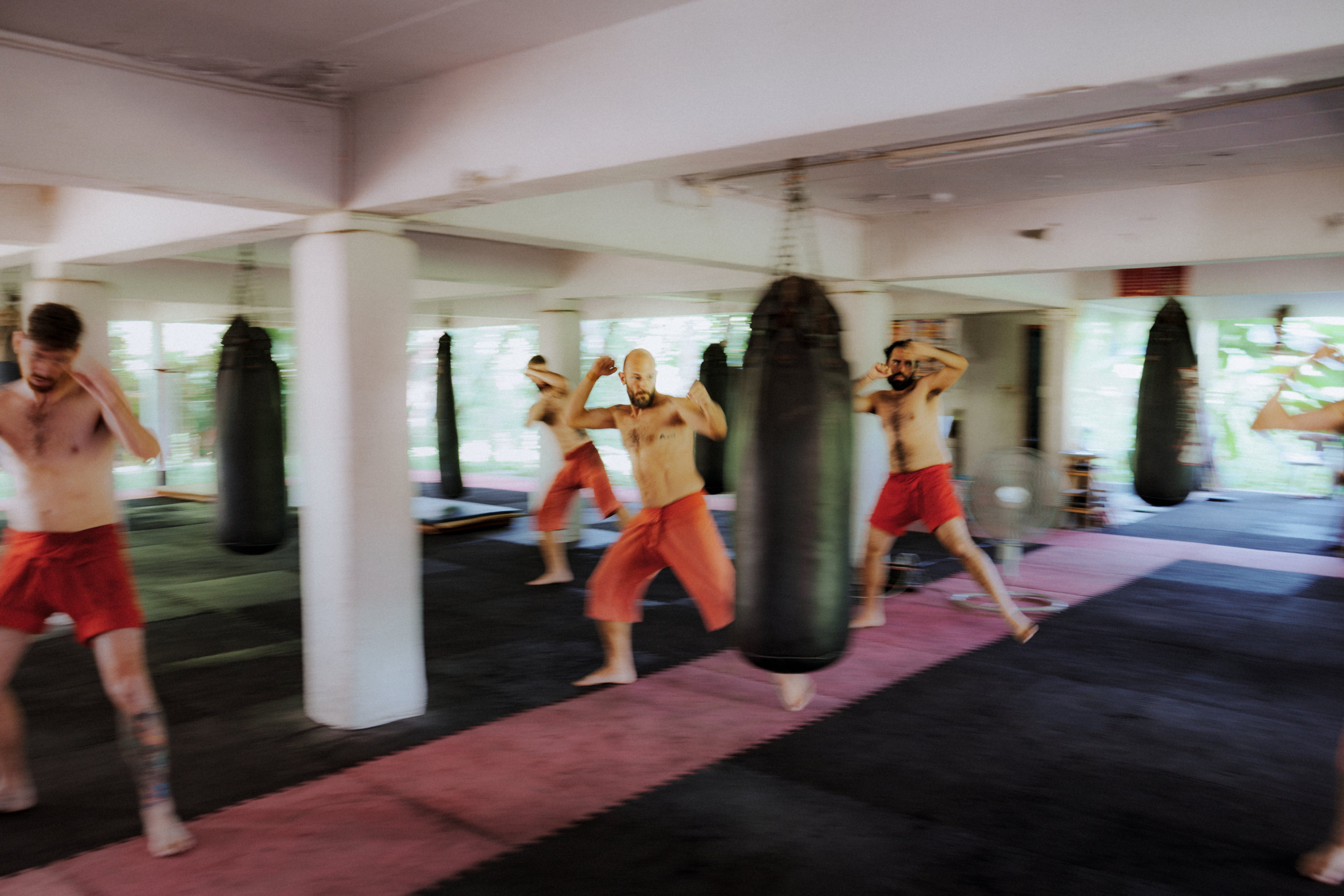
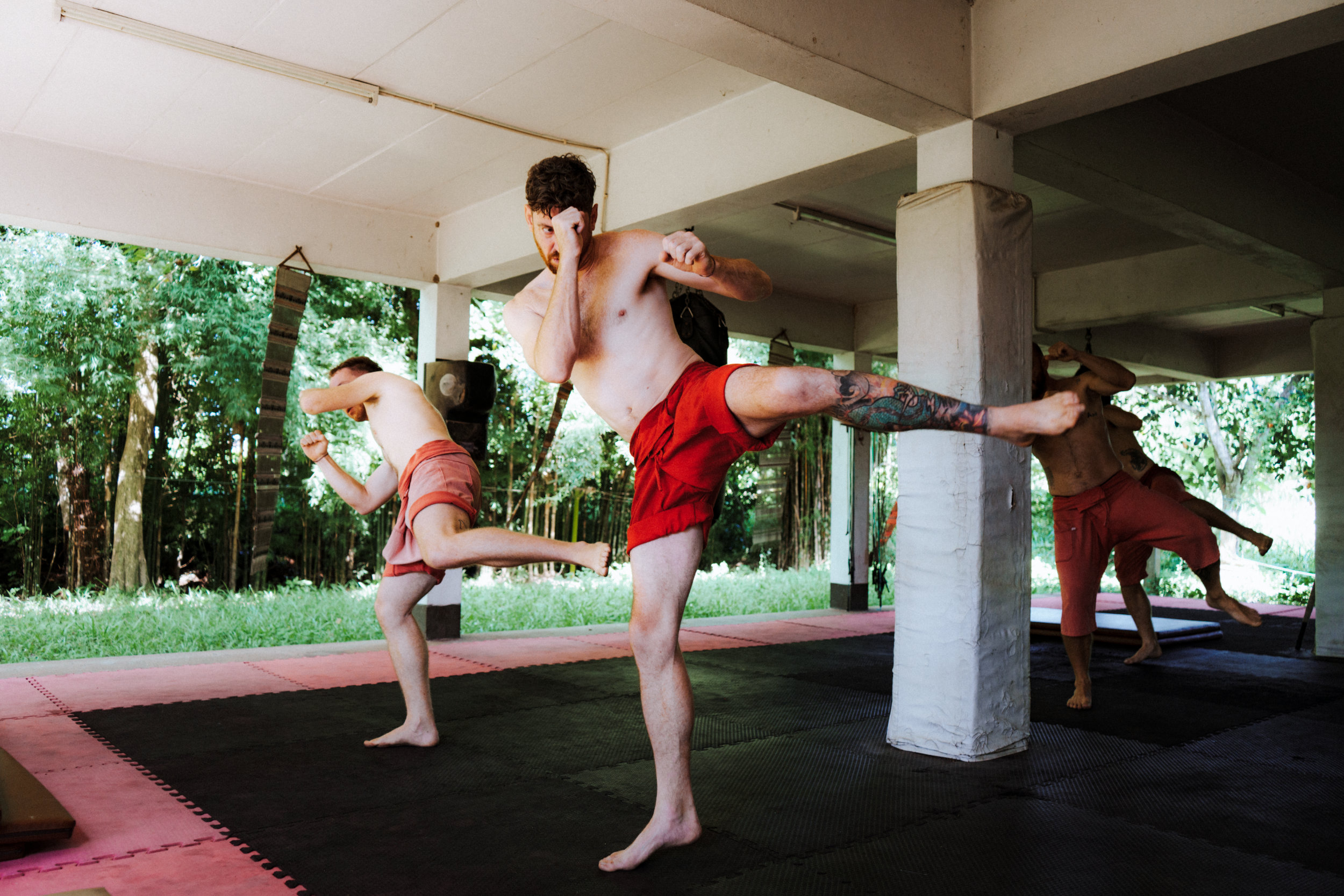
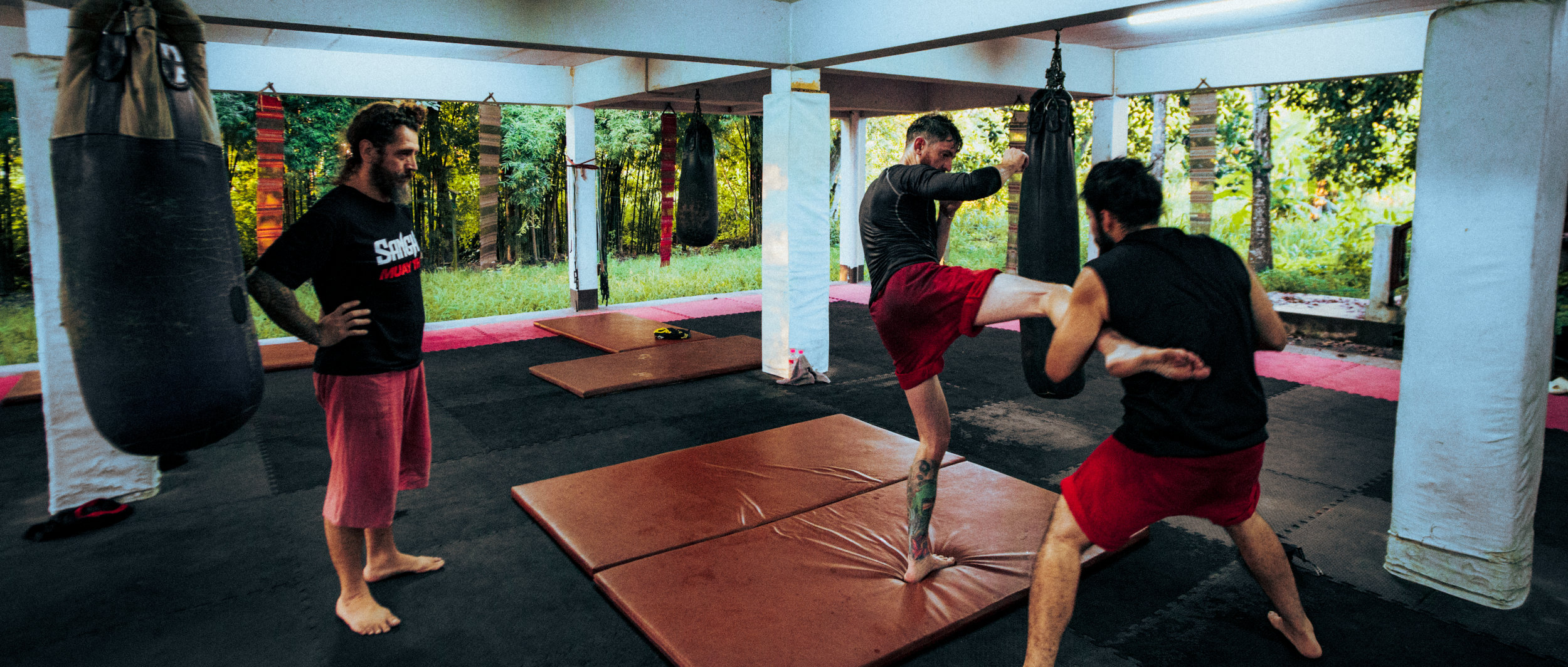
Stepping into the training arena, I was surrounded by punching bags that hung in every direction. It had no walls and was inside a lush and overgrown garden. Birdsong and the chirp of crickets flowed into the room. You really felt in touch with nature in this space. At the front end of the arena stood all the students making casual conversation. While some were still awakening from their sleep, others had been up since the dawn, practicing their meditations and breathing exercises. The air was relaxed and comfortable.
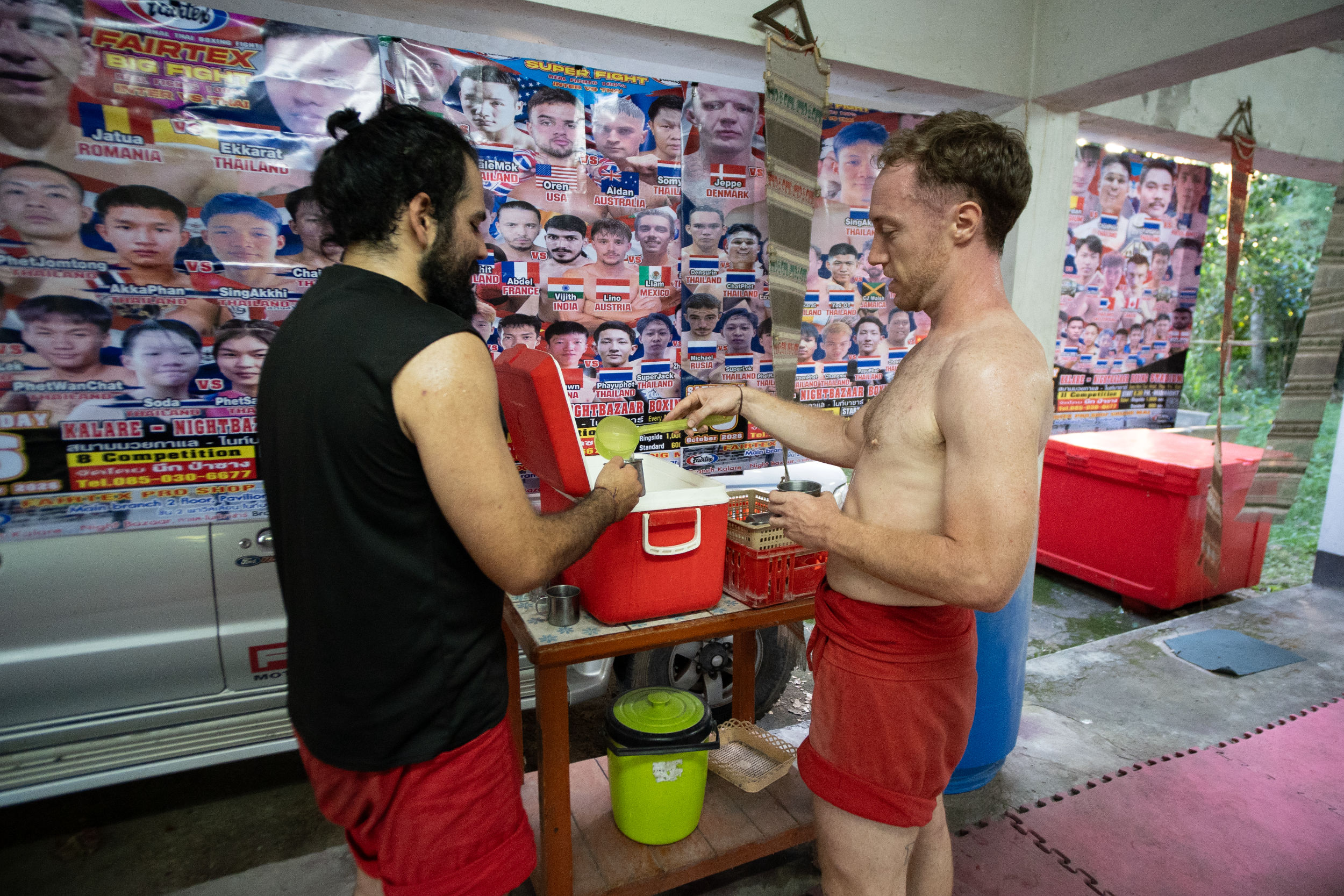
I was stepping into the third week of an intensive fight and spirituality course, of which the students traveled from around the globe for. They came from Mexico City all the way to Switzerland. Though many of them have never met each other before these last three weeks, this morning they were well acquainted and sharing laughs, as well as pouring cups of water for each other to hydrate before their arduous workout
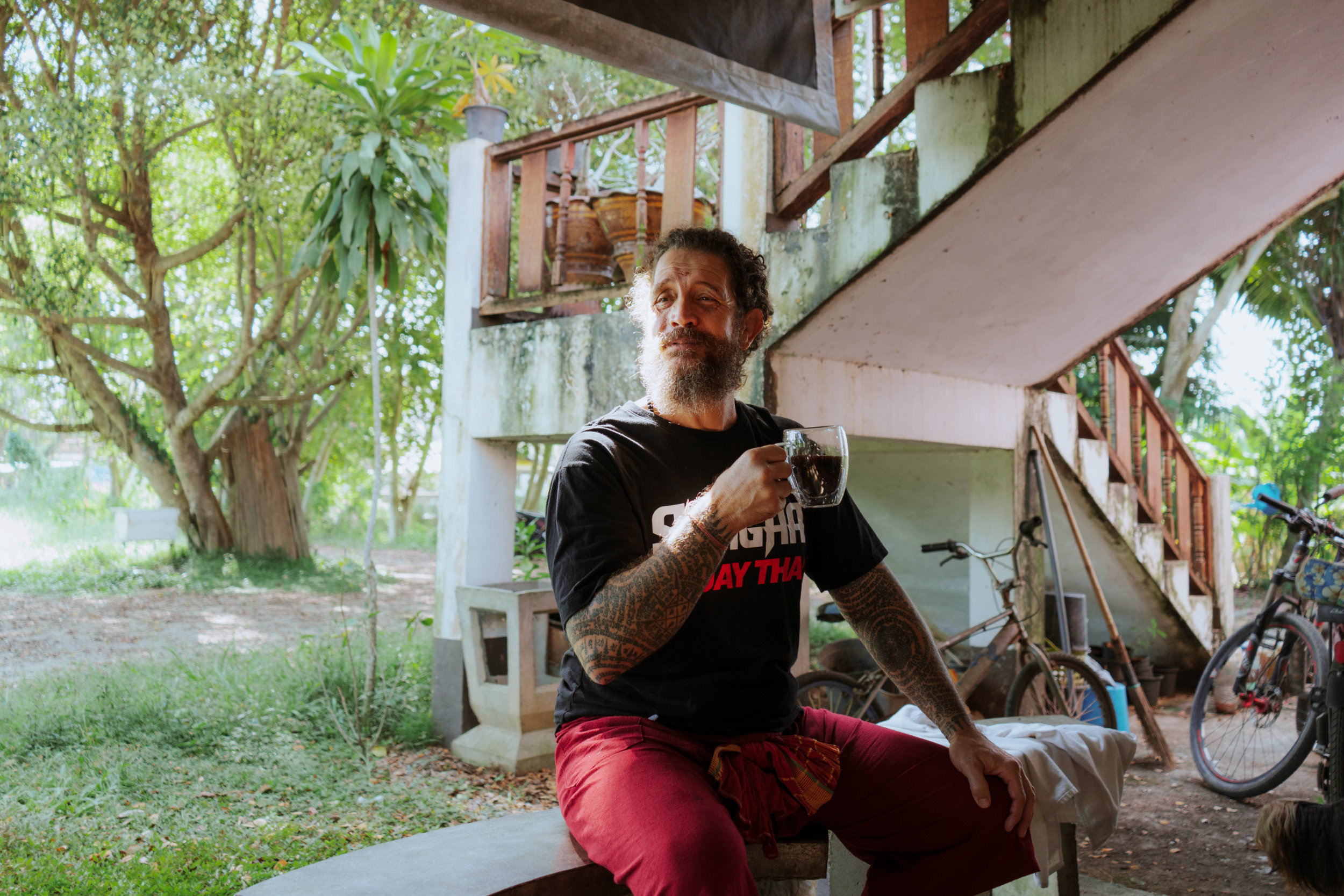
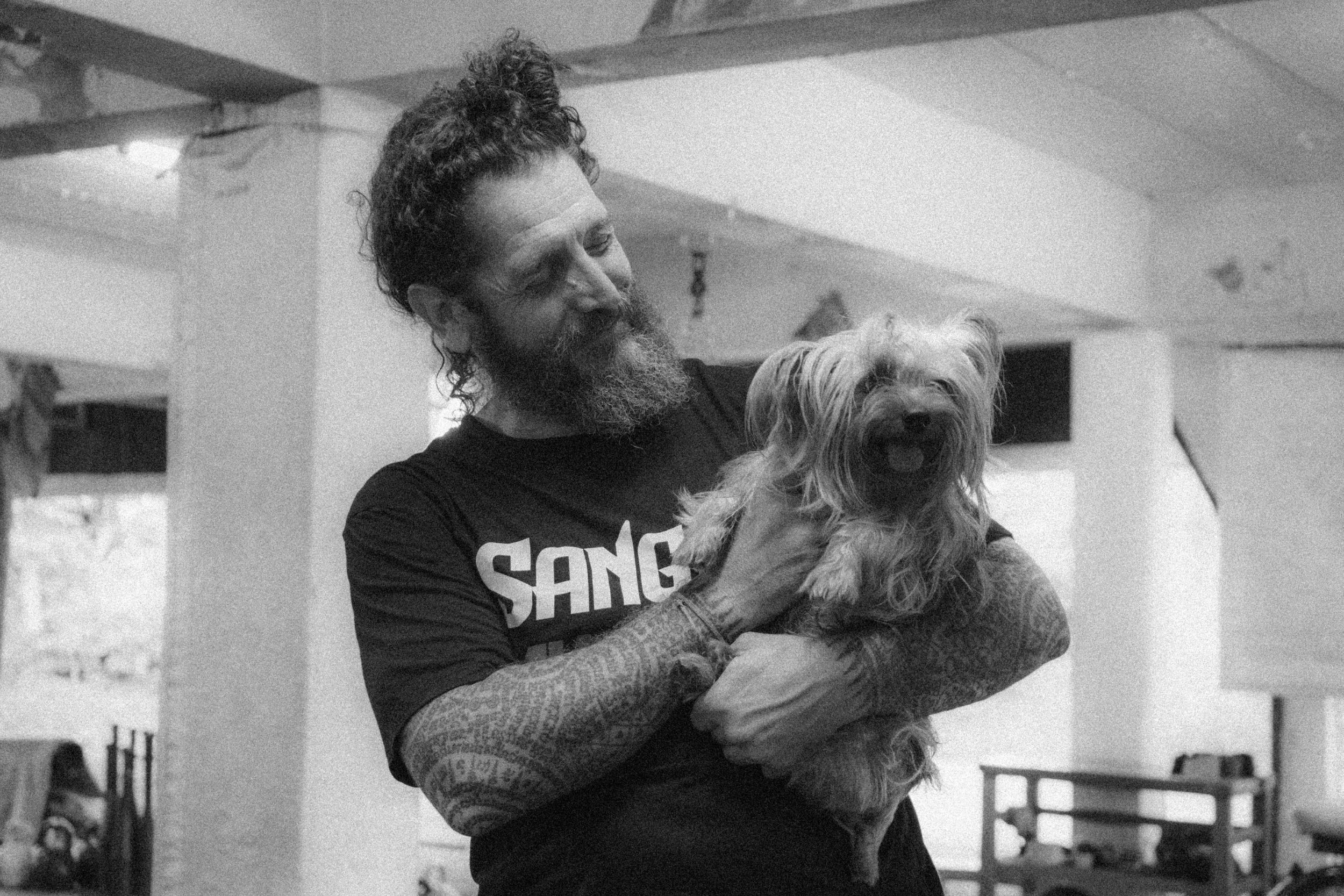
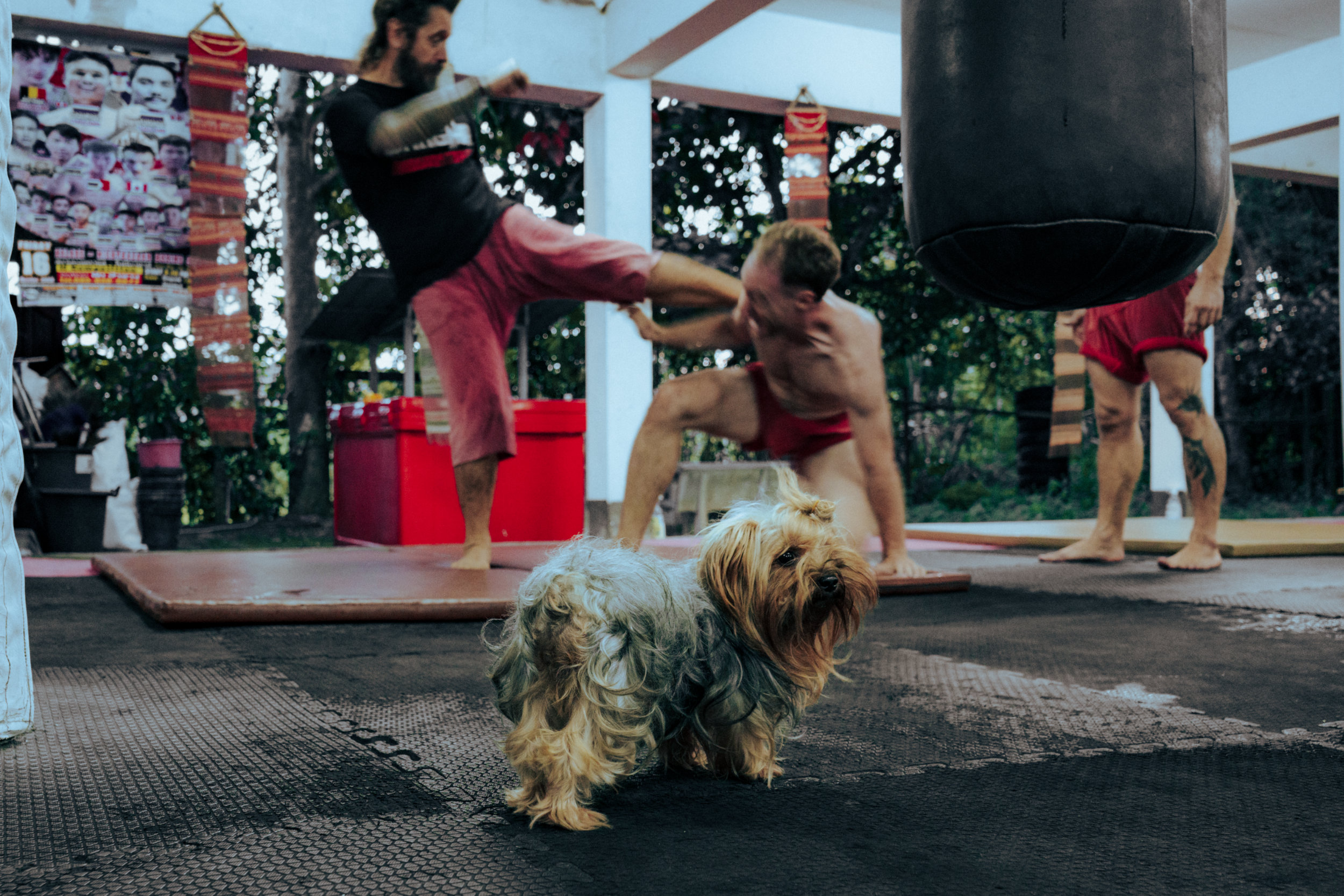
“Good morning!” Pedro shouted with a thick Spaniard accent. He sauntered in with a coffee in hand, and with three furry little dogs trailing behind. He noticed the fresh Sak Yank ink on Jon’s back and immediately called the group over to admire the new work. That’s when I noticed a couple more members had similar inscriptions on the skin of their backs too. These warrior tattoos were a real and lifelong commitment to a path of spiritual martial artistry. I was in no tourist-trap fight class. This was a proper fight club. Through and through.
“Get in line!” Pedro ordered. Everyone scrambled to formation in front of him. Pedro stood in front of his students while they waited for his next order. “We’re are going to do this morning, combinations.” Pedro called to a student. “Today, Adrian is going to lead.”
Adrian stepped forward, and Pedro began.
“One!
“Two!
“Three…!”
Pedro moved into a different fighting stance with each number he called. His fists clenched and his arms stiffened, bending at the elbows. Adrian watched attentively. “…Four! Five!” Pedro shouted, striking his foot into the floor.
The teacher sat down and Adrian stepped to the front of the group. The students all realigned themselves, facing the far end of the arena. “Ready!” Adrian called. “One!” The group lifted their leg, twisting their torsos to the side and back. “Two!” they continued. The drills went on to the end of the floor and back while Pedro kept a close eye, peeking over the rim of his coffee mug.
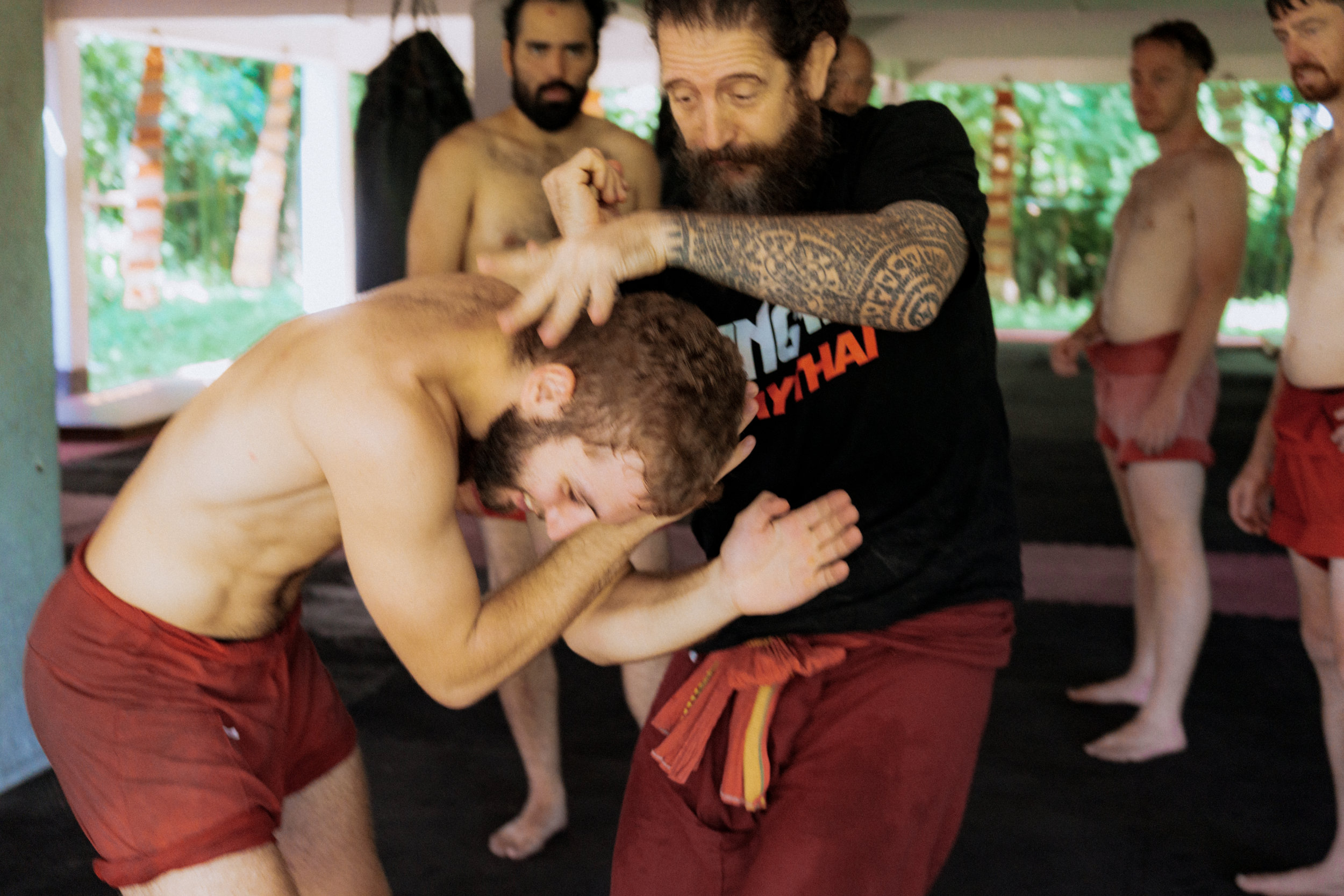
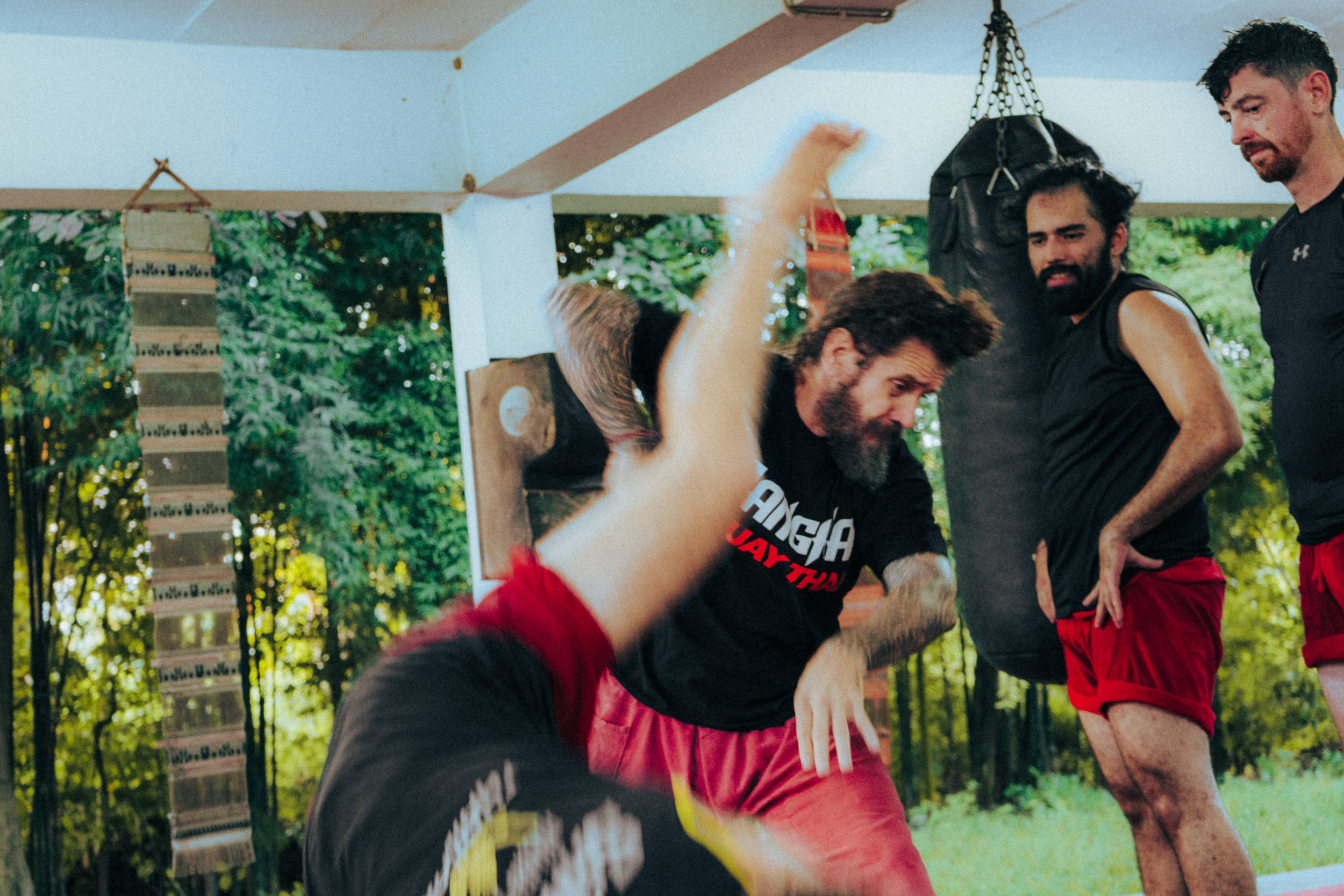
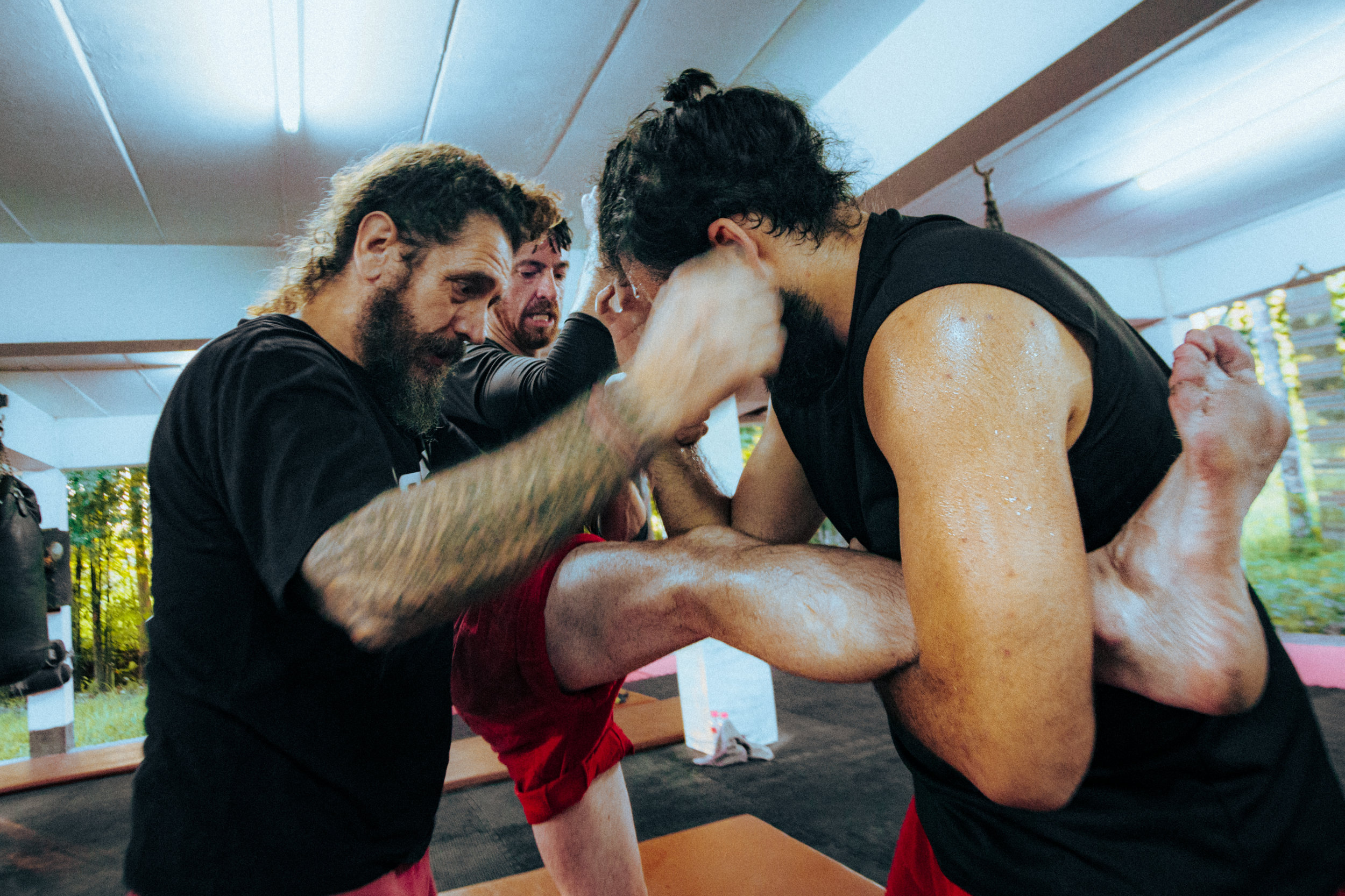
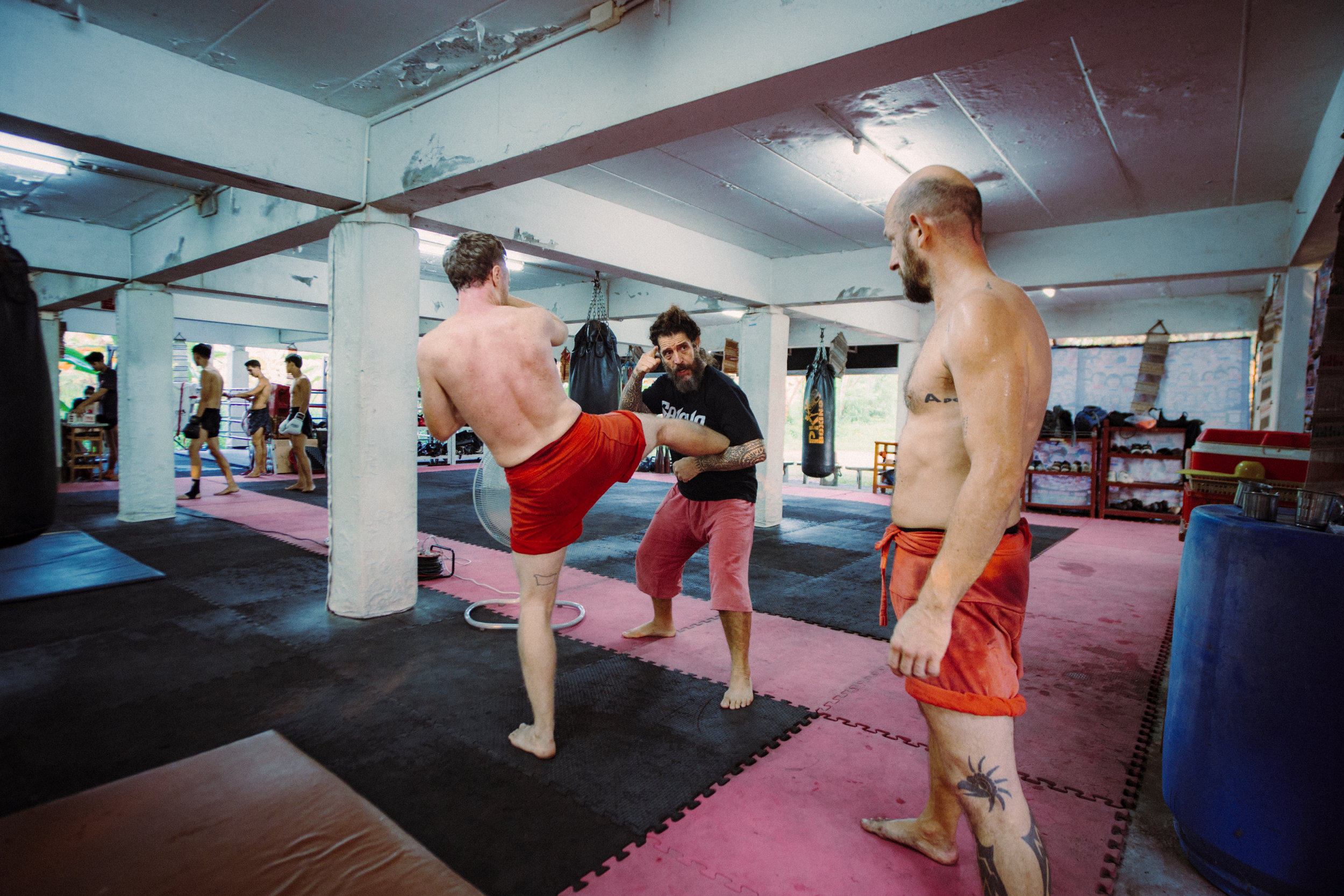
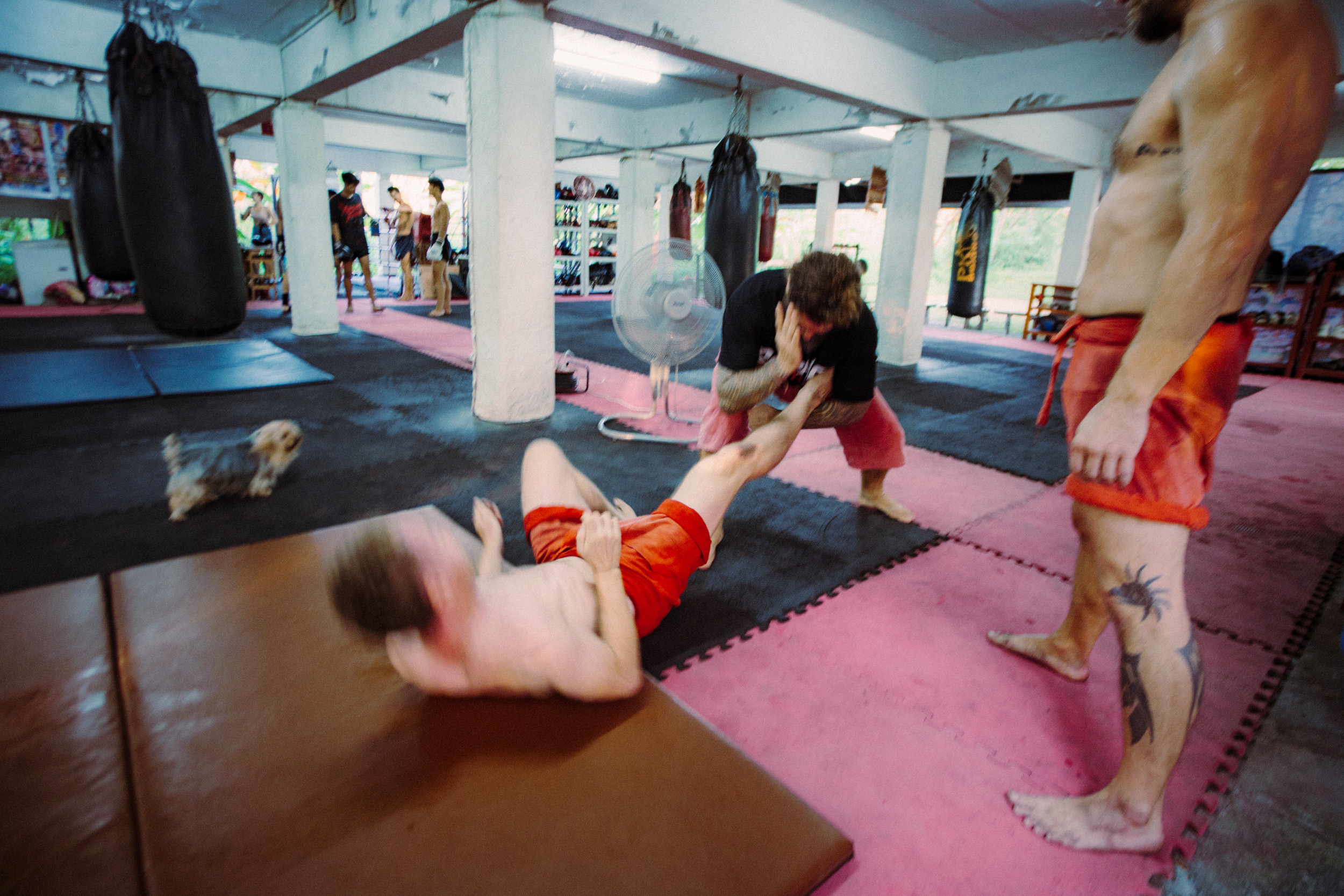
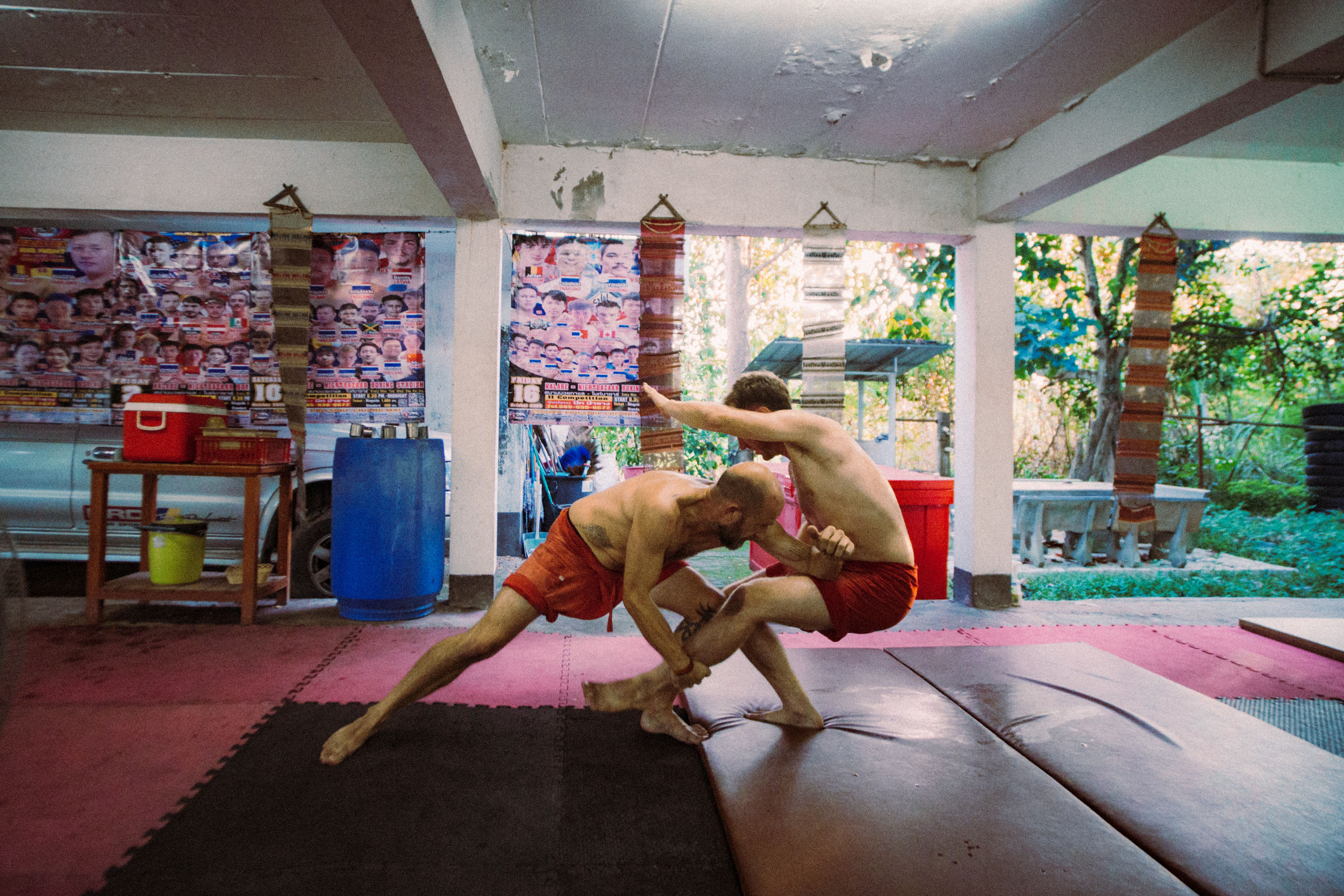
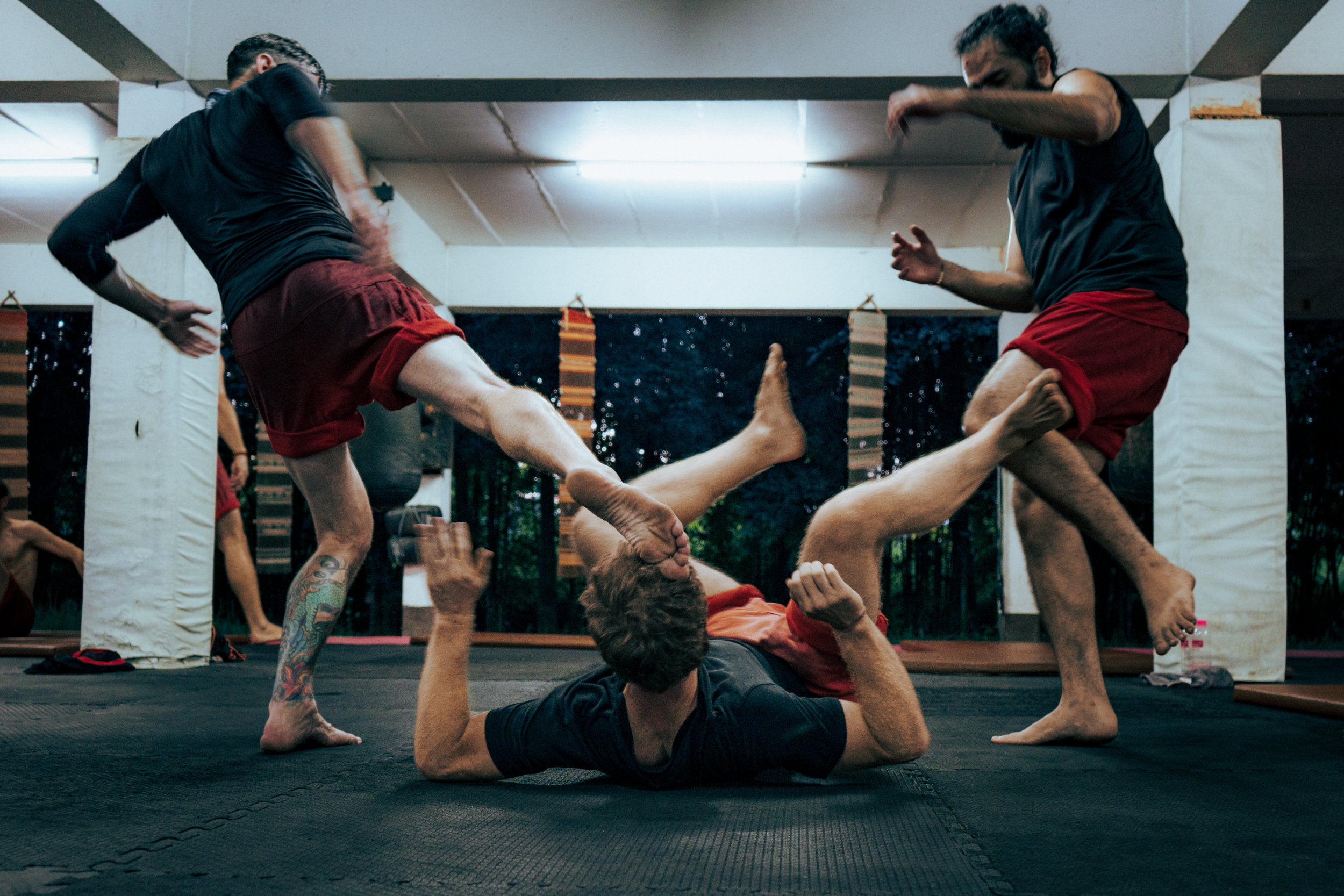
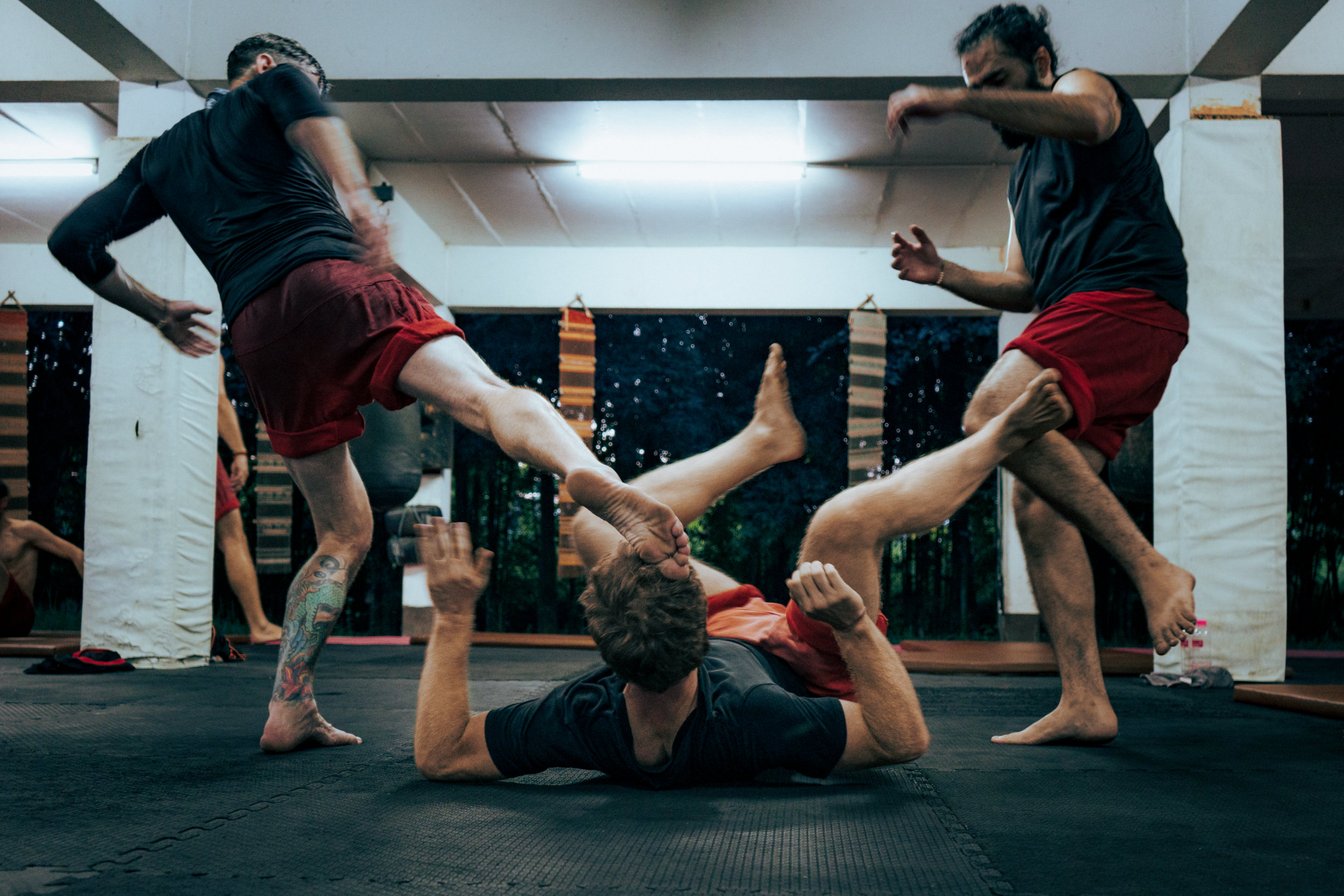
This was an exercise of control and balance. Kru Pedro stood and approached the group, asking them to continue their drills so that he could step in and adjust their form. He’d throw some fun into the interaction by besting his students. The student would be asked to demonstrate a move, and as soon as they'd make a mistake, Pedro would make his move. He'd give them a kick, a smack, or just take them down all together. From there he'd walk through the ways they'd protect themselves against his technique step by step before sending them off to practice either against a bag or by shadow boxing.
Over the course of many days I observed these classes and saw that Kru Pedro’s demeanor was quite playful and informal—contrary to what you might think of a typical martial arts coach. Most would expect a sculpted macho man who barks orders to be at the head of a place like this, but what I found was a relaxed, cool-headed, sort of schlubby man who sometimes walked through his classes with a hot drink or a piece of bread in hand. Though this appearance is far from what the typical “marketable” martial arts teacher reflects, it’d be a mistake to underestimate him. Watching him at work quickly makes it apparent his decades of experience.
With everyone tiring around noon, they headed up to the meditation room, and sat around in an imperfect circle. Before group meditations, Pedro would often go on a monologue. He’d give mini-lectures about self-awareness and the like, or go on a diatribe against some aspect of modern life. After a while, they would all fall silent and ease into a meditative state.
I had the chance to join them for a few days of this practice. Though done as a group, the meditation is really meant to be a personal experience. Some sit for a few minutes before silently standing, and stepping out for lunch, and others stick around longer, diving deeper to advance their meditative journeys. I’ve never meditated in a group setting like this. Only recently I’ve grown comfortable enough to meditate in the presence of my own wife, so you can say that I was a bit distracted while attempting to do so in front of the nearly dozen people. I decided I’d simply ignore any effort to concentrate, and simply close my eyes and listen to the birds outside. In its own way, that counts.
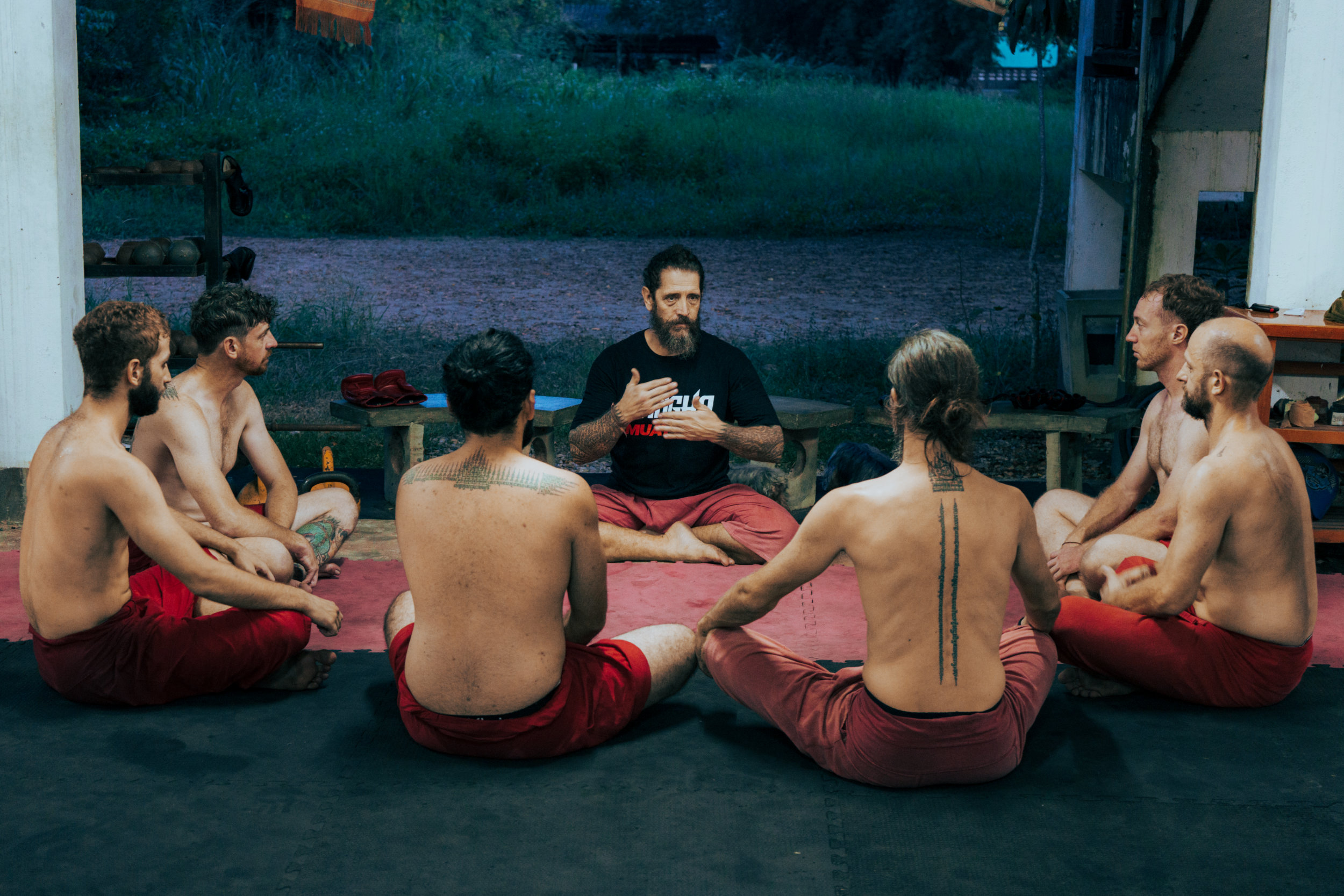
One by one I noticed the students trickle out of the room and make their way to their bikes and hit the road for their mid day break, so I went and grabbed my film camera, and hopped onto my own motorbike to follow suit.
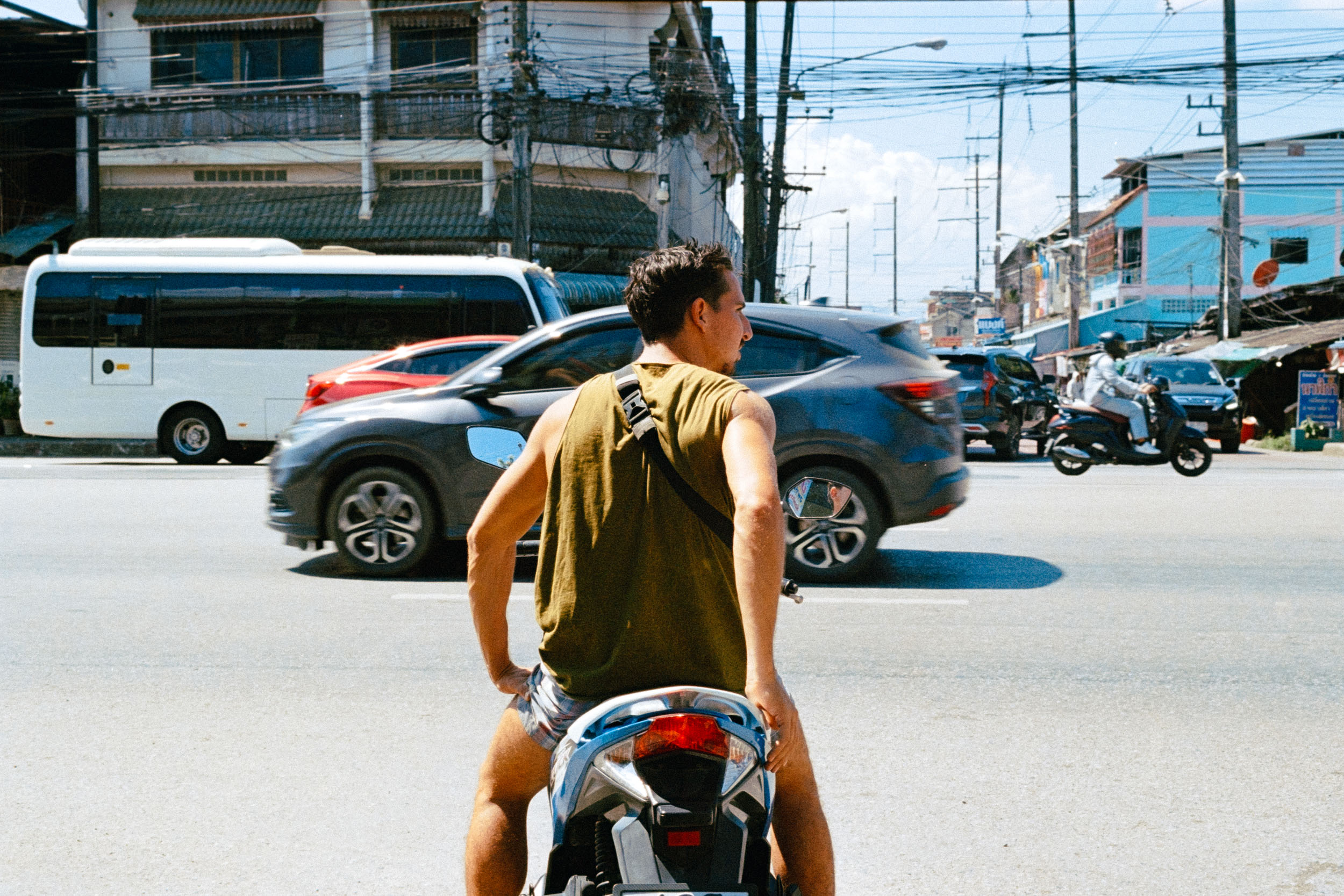
After parking our bikes under some shade, we arrived at a small kitchen serving casual Thai food. It was myself and three other students sat at a little dining table, all of us ordering some variation of a holy basil with rice and egg dish. After the intense training of the morning, it was a nice respite to sit with a hot meal and some company.
I asked a few questions to find out what these people are getting by being at the Sangha Spiritual Warriors School. A common through line was to step away from anxiety or stress back in their home countries. They had pressures from work, their finances, and larger social expectations that compiled over long periods of time and ultimately lead them to question:
What really matters at the end of the day?
We’re all the product of our respective societies. We are given customs and traditions—codes for living a life that decides what we believe about the world and how to act in it. A Value System. Often times, these value systems tend not to work for some people, and rather than accept the misery of being incompatible with your society, one might choose to leave in search of something more. For some, they'll find a new point of view, and others, they'll discover a new way of life entirely.
Another curious discovery I made is that a few of these people were quite successful, having earned their spot in high-paying positions back home. But ultimately those positions lacked any sense of fulfillment to them. In some cases these success stories were actually the source of tremendous anxiety and stress, generating a mountain of responsibility with no apparent purpose.
These members of the Sangha Spiritual Warriors School were on their third week of a month-long intensive. Jon of course, was a returning student, and although the others were first timers to this school and its philosophy, they were still long time practitioners of martial arts. Learning to fight is one thing. Learning to not fight yourself is another.
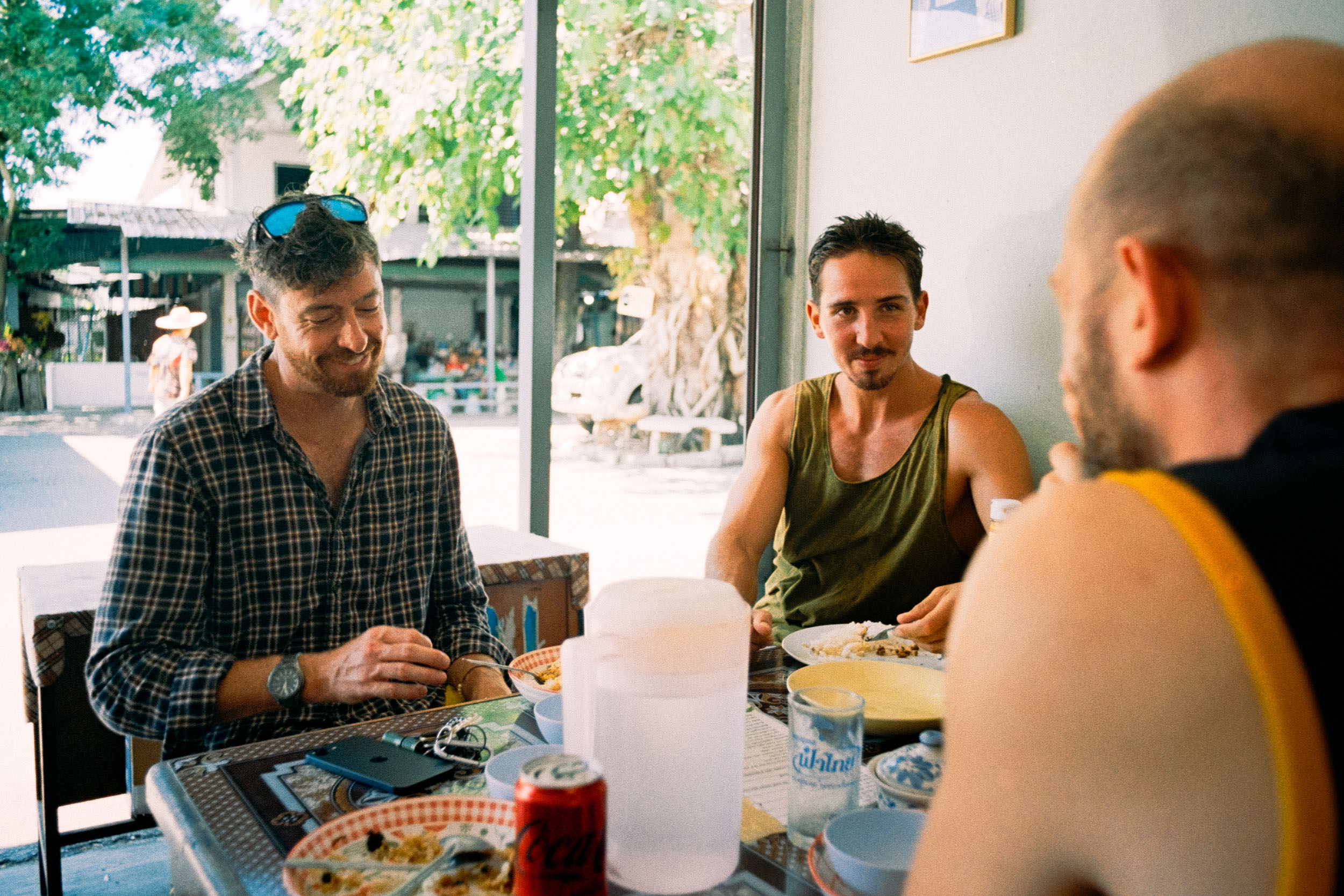
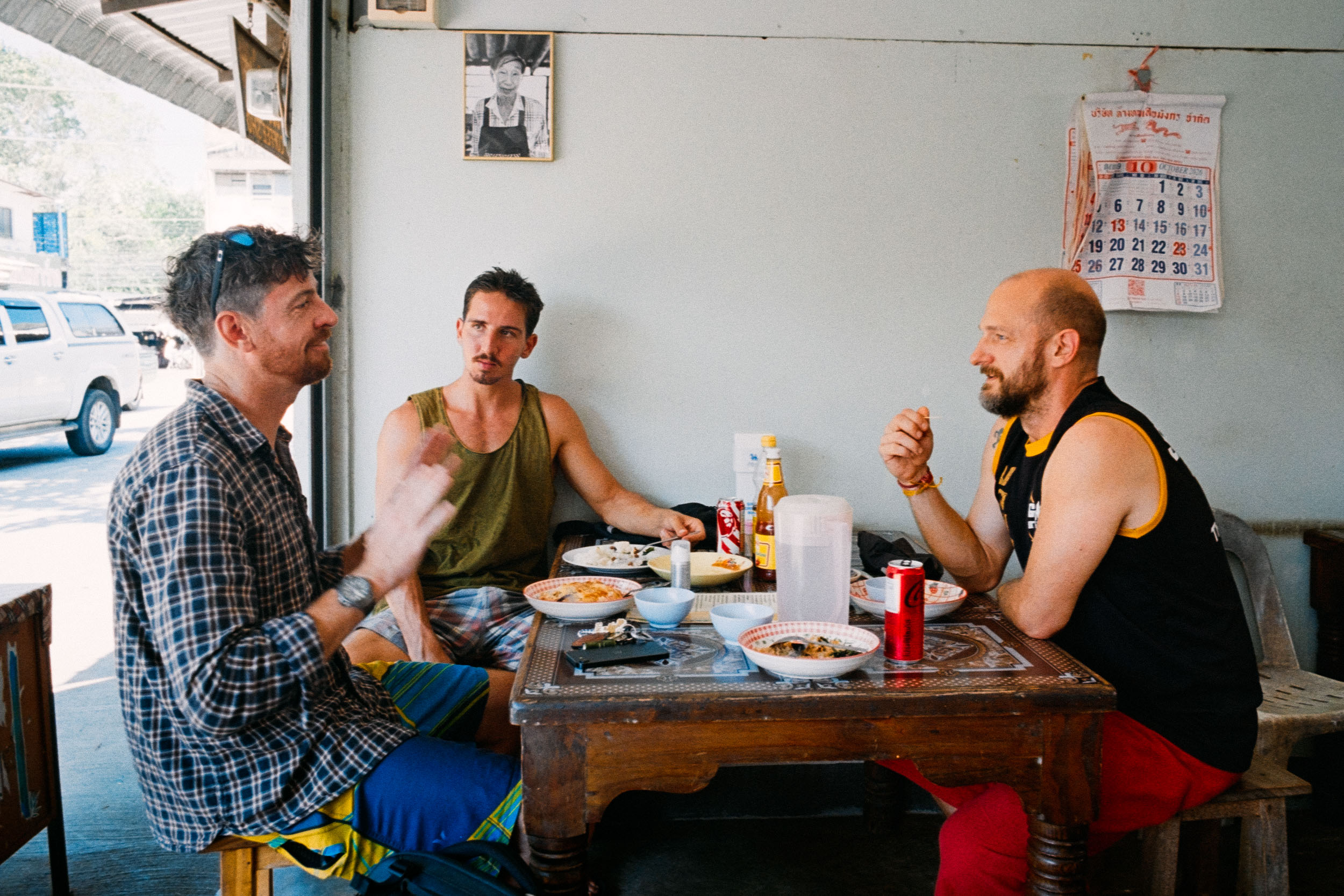
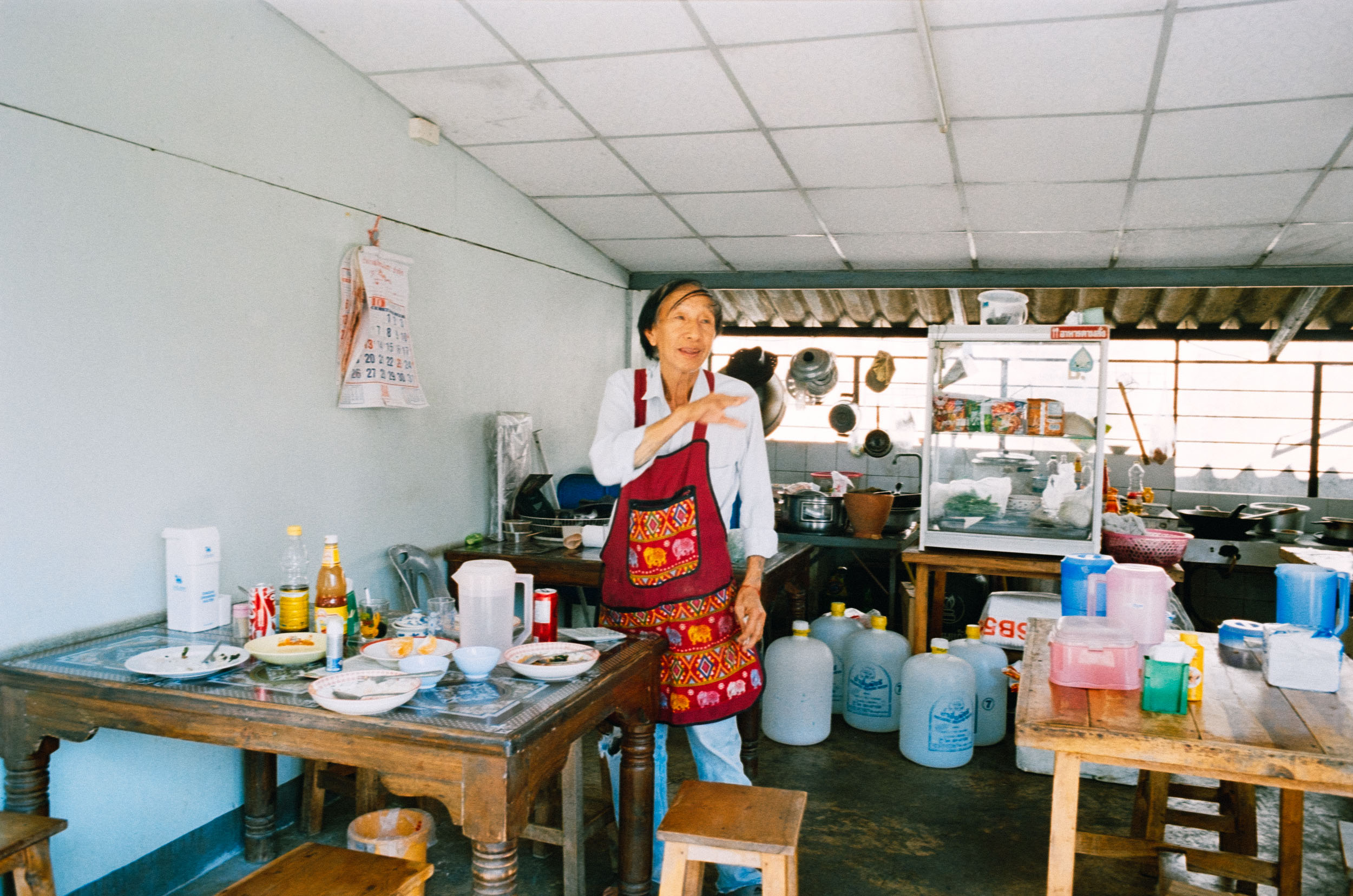
After a pleasant meal, we paid and said our farewells to the kind man who cooked for us, and headed back to the quarters. The guys retired to their rooms to rest before the evening’s training, and it was during these lulls that I would sit and write to gather my thoughts on this whole experience.
“Sangha means community…
…so it’s the community of warriors that want to upgrade their spirit.”
Over the many days at the school, I had the chance to sit with Kru Pedro himself. I wanted to understand more about the unique martial art of Muay Sangha. What was the philosophy that guides him as a teacher, and what does he aim to achieve in sharing his teachings?
Pedro explained to me, “In our school the main purpose, through the martial arts and through the practices that we do, is to be able to understand our ego, our mind, our fear and our emotions—and to be able to transcend them. Not with force but with constant inner work until [the ego] becomes weaker so that the true self can rise.”
He smiled at me. “Now you will ask me, ‘What is the true self?’.”
“Right.”
“True self is what lies beyond the ego and the mind. The consciousness that is there before you learn [anything]. The divine sparkle. That is the true self."
Fascinating stuff indeed.
He went on. “So when we born (…) we absorb. We learn, and the true self [moves into] the background. And we function normally until for some individuals, their life is not enough.”
This tracked with my conversation over lunch with the others. “Go on.”
Pedro continued, “They want to go further to find out why they are unhappy, even if they achieve everything! Some of them come here, and they enter into a journey of finding their true self.” Pedro took a breath. “So that is the purpose of the school. Bringing people to know who they really are.”
A common occurrence would happen during my conversations with Kru Pedro in that I would meet the ends of his monologues with silence. I so desperately wanted to fill this silence to show that I found his words useful and good, but nothing would reach my tongue. So I would just return his words with a smile.
He’d laugh, and mention how that was a common response to his talks and explanations.
I asked him, why martial arts? What does Muay Sangha and its physical intensity have anything to do with spiritual development?
“When you press yourself beyond your limits,” Pedro started, “there is a lot of growth.”
One of the little dogs climbed onto his lap and fell asleep.
He continued, now petting the dog, “We push the student in a situation which is uncomfortable, and then when emotion arises, we stop and tell students ‘Look at that emotion. Where it comes from? Why is it triggered?’ Martial arts is a good opportunity to see yourself, study yourself. [So] when I am teaching I [become] resistance and I enter a role that is able to provide the [challenging] situations for the students.”
“Why is that pressure important for spiritual development?”
“When there is no pressure, everyone is happy. But when there is a situation in which chaos appear, then that is when the emotions within you have a chance to be expressed—because most of the people hide their emotions. Most of them are like, a double [life], ego in front—everything okay, but inside it’s completely different.”
This is the awareness that seems to be at the center of it all. The ability to recognize what makes you tick, how you respond to challenges and how much of it you can take. It certainly is good to be aware of the fact that pressure might make you emotionally irrational, or angry, or dismissive. Pedro believes these are things you can't learn without the introduction of some guided hardship.
The art of Muay Sangha at its philosophical core, is about learning to navigate life better. You learn to be conscious of yourself and the world around you, and through that, you can enjoy the ride instead of being dragged along as a victim of it. Life comes with pressure, and awareness can help us manage those pressures.
Simple Life, Simple Mind, Simple Spirit
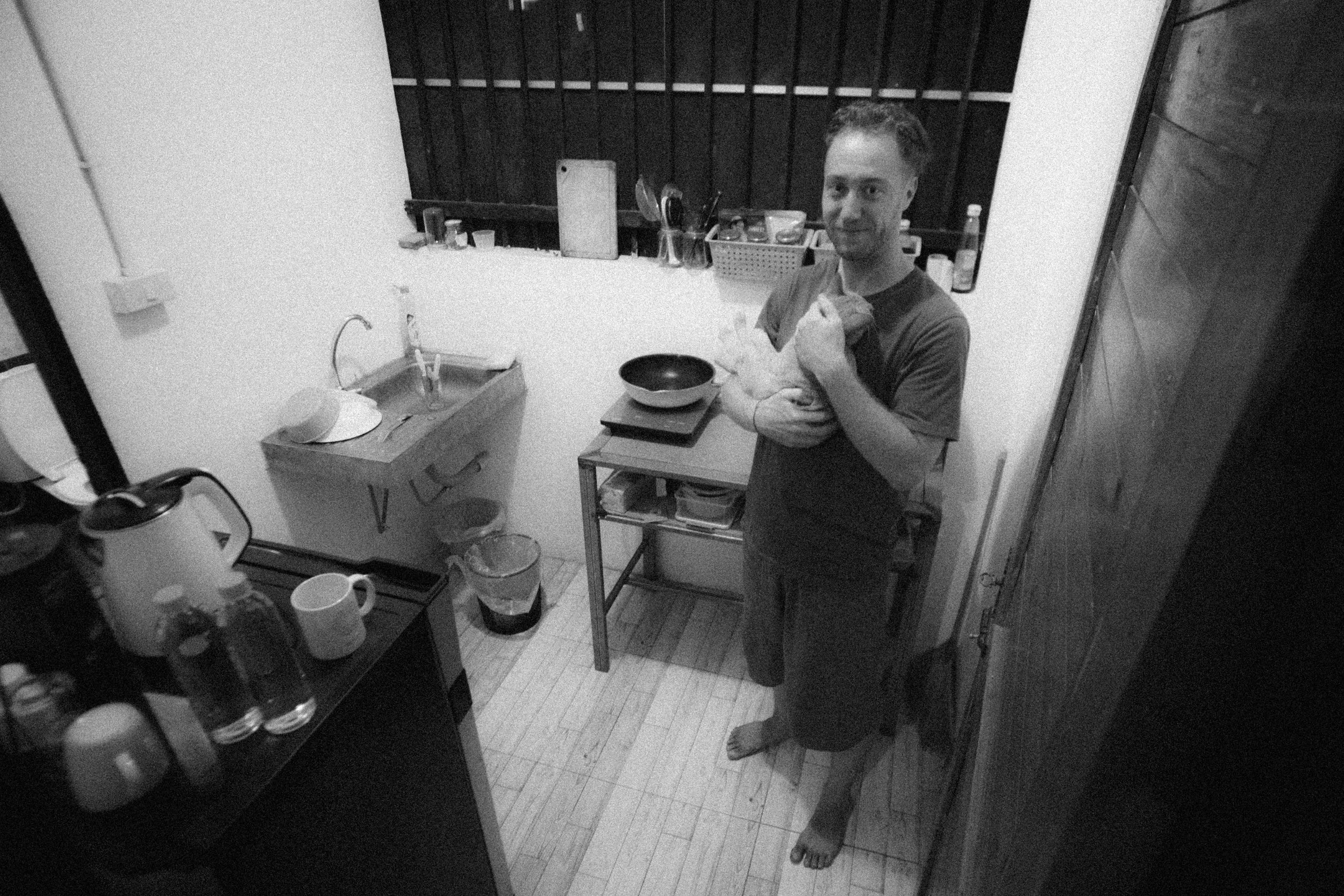
“In the evening, usually when I come back, I cook,” Nick from Switzerland told me. He's been spending the last 13 months training with Pedro, and invited me to tour his quarters and share more about his year-long journey in Thailand. His room was humble. A single space with a closet, a bed, and a little desk. In the outdoor kitchen was a table with a plug-in cooktop, a sink for washing dishes, and a little refrigerator. All things considered, the room was just a space to sleep and be alone. Nothing more. “I feed the cat, I have a shower, go to cook something, eat, wash everything, and already it’s night.
“Living in a simple life outside you can be focused inside. In my life in Switzerland, I had a lot outside but I didn’t have the time to go inside (…) In this room, I have nothing to do, no friend to call, nothing. What I do in that case, I read a book, or most of the time I meditate. In Switzerland I always wanted to meditate but I never do it because I always had something else to do. That’s why a simple life is really the key.”
Nick finds the relationships he has with others and himself to be the only thing with meaning these days. “Learning about myself is much more important than everything. You want to take something? Really. You welcome to take it I’m…not attached to this.” He gestured around to the kitchen.
“Where do you see your journey going from here? You’ve been here for…"
“A little over one year I think… I have no idea. For my whole life I had plan for my future, but today I don’t (even) have a plan. It’s just going inside [to] discover really who I am.”
Silence settled in the room.
He started again, “For the first year here I had a lot of expectation. 'If I do my meditation, if I train good something amazing [will] happen,’ you know? After one year nothing crazy happened and I was kind of disappointed. I realized it was the wrong way. You should not expect anything. Just be on the path, be in the way, do your best. The problem is that when I came here I was expecting [something amazing], and now I have less expectation. Just try and be happy with what the day brings.”
During our talk, Nick was accompanied by an orange cat that he took in almost a year ago when he arrived. Among the few belongings he had was bowl for cat food and water. This cat, he explained, was more than a pet: “He’s like a friend—a brother.” The company of the animal was quite the assurance.
“Are you at peace?” I asked.
Nick turned his head, looking for an answer. “No. Not at all.” He said it with a smile and broke into laughter. “I am more in peace than before, but no. Not in peace today.”
The cat started to meow, and I continued with my questions. “You said more than before?”
“Yeah, more than before, because I start to go inside, but when you discover what is inside..." He paused. "Right now I am not in peace—and being in peace is not longer the goal.”
The cat wouldn’t stop meowing over our talking, so he picked him up. “Are you in peace?” he said with a chuckle. He then continued, "You always have something in life that will break your peace (…) Sometimes you are in peace and you enjoy it, but when you are not... fight.”
He wiggled his finger in front of the cat's nose. “I may need a lot of love, but I think more, I need to give love.”
“For so many years, thousands of students have improved many aspects of their lives…”
It was my final evening with Pedro, who was jumping in and out of instruction to speak with me. The loud smacks of punching bags echoed through the training arena. “I’m very happy that we can use martial arts to help humanity, to improve their health, their confidence, their discipline, and to teach them how to work with their emotions.” He stepped away to explain the next set of drills to the group before running back to me and my audio recorder. “This is the main purpose of our school Sangha Spiritual Warriors—using martial arts to upgrade humanity as best we can.”